
The Ultimate Formula 1 & Hungaroring Masterclass: From Racing’s Infancy to the Future
Introduction
Formula 1 is the pinnacle of motorsport, where human courage meets engineering genius at speeds that defy imagination. For Central and Eastern European fans, the Hungarian Grand Prix at the Hungaroring holds a special place — a symbol of global connectivity, sporting passion, and the relentless pursuit of excellence.
This comprehensive study guide takes you on a journey from the earliest days of motor racing through the birth of Formula 1, the development of open-wheel racing categories, the sacrifices young drivers endure, and the cutting-edge challenges facing the sport today. We’ll explore Hungary’s unique motorsport history, the iconic Hungaroring circuit, and what the future holds for racing.
Whether you’re preparing for the WinJourney Quiz or simply want to master the thrilling world of Formula 1, this guide is your definitive roadmap.
The Genesis — When Speed Became Sport
The Birth of Motorsport: An Impossible Dream
Motor racing began almost as soon as the automobile was invented. The earliest “races” were not organized competitions but rather tests of survival — daredevil attempts to prove that these new machines could travel faster and more reliably than others.
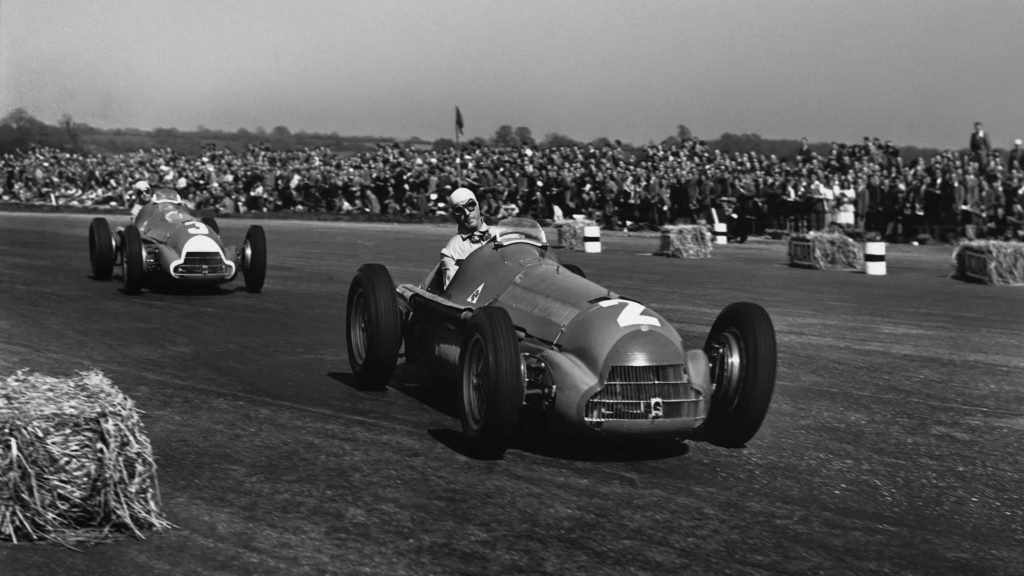
Key early racing milestones:
- 1894 — The Paris-Rouen Race: The world’s first organized automobile competition, judged not on speed alone but on safety, reliability, and ease of use. It was essentially a competition to find the most practical horseless carriage.
- 1906 — The First Grand Prix: The Automobile Club de France organized the first official “Grand Prix” (Great Prize) at Le Mans. This introduced the revolutionary concept of the “formula” — standardized rules governing engine size, weight, and fuel, ensuring fair competition.
- Early racing dangers: These city-to-city races were incredibly dangerous. Cars had minimal protection, drivers wore leather caps instead of helmets, and spectators lined unprotected roadsides. The Paris-Madrid race of 1903 was so deadly it was stopped mid-event, with officials refusing to let it continue.
Fun fact: In the very early days, cars couldn’t be maintained by a single person. Drivers had to carry a “riding mechanic” in the car with them to make repairs during the race. This mechanic would shift gears, adjust fuel mixture, and fix breakdowns while the car was still moving — all while sitting next to a driver traveling at dangerous speeds!
The Golden Age of Grand Prix Racing
By the 1920s and 1930s, Grand Prix racing had evolved into a sophisticated spectacle. National pride, technological prowess, and manufacturing prestige were all at stake.
The era of legendary drivers:
- Tazio Nuvolari (Italy): Arguably the greatest driver of the 1930s, Nuvolari won through sheer skill and courage, often in inferior machinery.
- The Silver Arrows (Germany): Mercedes-Benz and Auto Union dominated with government-backed engineering programs, producing sleek, silver cars that represented German technological superiority.
- Ferrari (Italy): The legendary Italian marque joined the Grand Prix circus, setting a standard for passion and performance that endures today.
Open-wheel racing defined: Open-wheel racing emerged as the premier category because the exposed wheels and minimal bodywork made the engineering visible and the competition transparent. Unlike enclosed cockpit racing, every advantage (or disadvantage) was obvious to spectators.
Hungary’s Early Motorsport Heritage
The 1936 Hungarian Grand Prix: A Lost Legacy
Long before the Hungaroring existed, Hungary hosted a world-class Grand Prix. On 21 June 1936, Budapest became the stage for a legendary race in the Népliget (People’s Park).
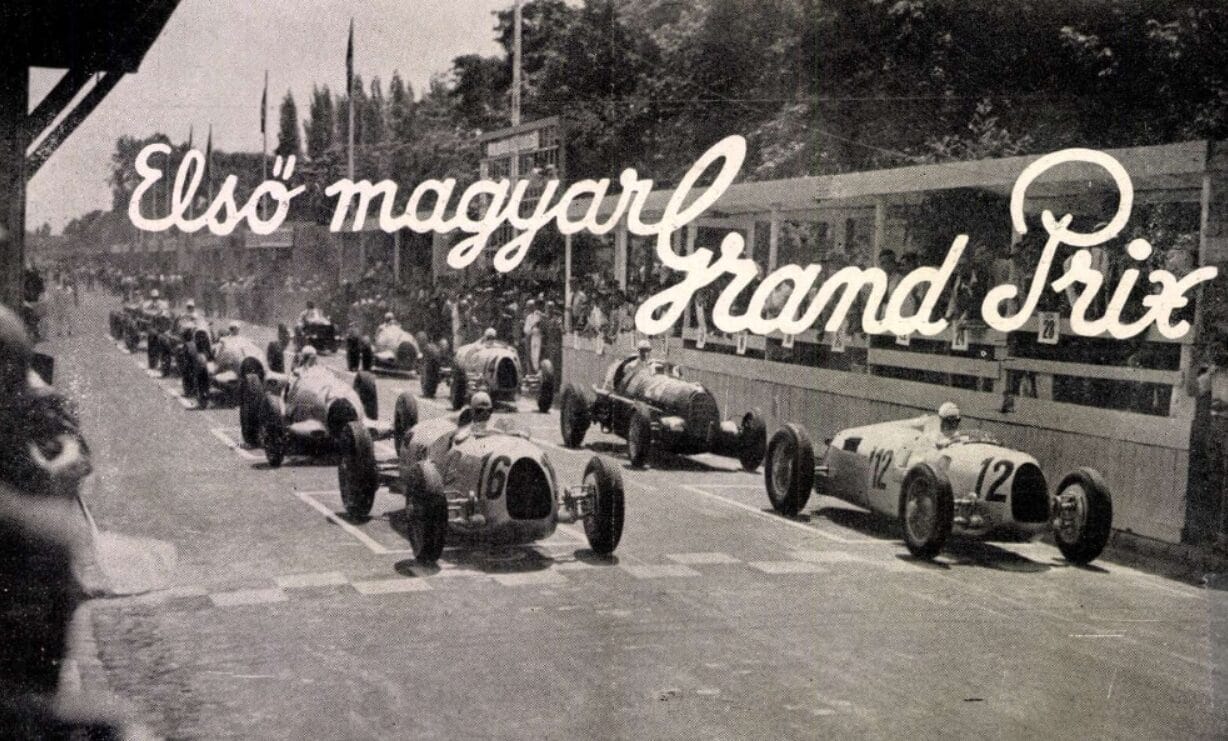
The significance:
- 200,000 spectators attended, drawn from across Hungary and neighboring countries.
- The race featured the best teams in the world: Mercedes-Benz Silver Arrows, Auto Union, and Alfa Romeo Ferrari.
- Tazio Nuvolari won in an Alfa Romeo, proving that Italian engineering and driver skill could prevail over German mechanical superiority.
- This race demonstrated that Hungary possessed both the passion and infrastructure to host world-class motorsport.
The tragic interruption:
Political tensions in Europe and the outbreak of World War II ended top-level Grand Prix racing in Hungary for nearly 50 years. Hungarian fans were left to follow international racing indirectly, watching newsreels and reading reports of races happening elsewhere. This extended absence would make the return of Formula 1 to Hungary in 1986 all the more momentous.
The Birth of Formula 1
The 1950 World Championship and a New Era
After World War II, the FIA (Fédération Internationale de l’Automobile) sought to create a unified, international racing championship with standardized rules.
The first Formula 1 season began on 13 May 1950 at Silverstone, United Kingdom.
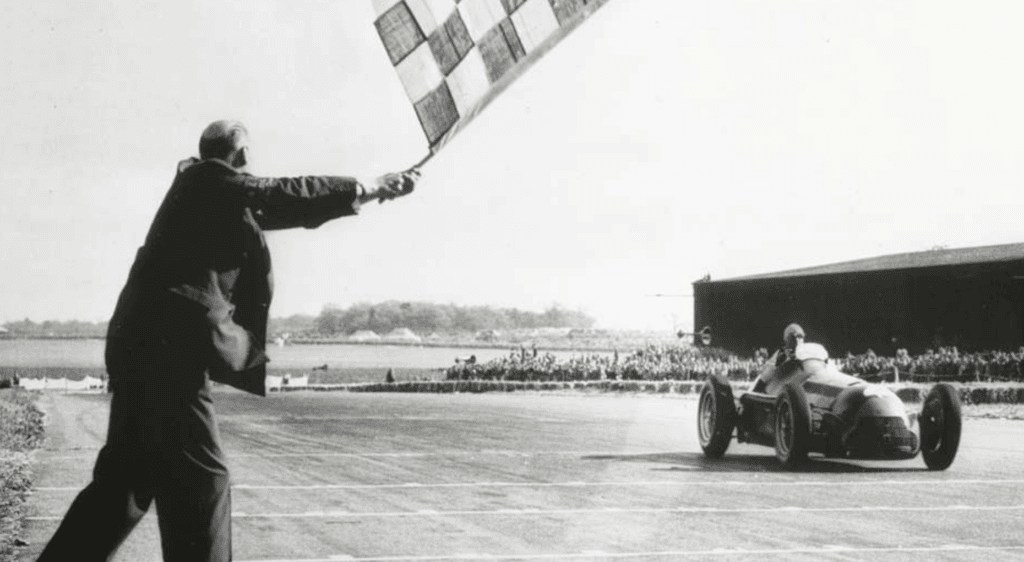
The characteristics of early F1:
- Front-mounted engines in long, cigar-shaped cars
- No seatbelts or meaningful safety equipment — drivers wore leather helmets and preferred being ejected from the car in a crash rather than trapped inside a burning wreck
- Mechanical simplicity compared to modern standards: drivers shifted manually, had no power steering, and relied on pure feel and strength
- Death was an ever-present risk — fatalities were tragically common
The Titans:
- Juan Manuel Fangio (Argentina): The “Maestro” dominated the 1950s, winning 5 World Championships with four different manufacturers (Alfa Romeo, Maserati, Mercedes, and Ferrari). His versatility and racecraft set a standard that few have ever matched.
- Stirling Moss (Britain): One of the greatest drivers never to win a World Championship, Moss epitomized fearlessness and skill.
The Technological Revolution of the Late 1950s
In 1959, the racing world was turned upside down by an unexpected innovator: Cooper, a small British team.
Cooper realized that placing the engine behind the driver (rather than in front) offered enormous advantages:
- Improved weight distribution
- Better braking balance
- Improved handling and cornering
Within a single season, front-engined cars became obsolete. This wasn’t a gradual evolution — it was a complete paradigm shift. Larger teams using outdated designs suddenly found themselves outmaneuvered by the small Cooper with its revolutionary mid-engine layout.
This moment taught the world an important lesson: in Formula 1, innovation matters more than tradition.
The Open-Wheel Racing Ladder
Understanding the Formula Categories
Formula 1 is the pinnacle, but it exists within an entire ecosystem of open-wheel racing. Young drivers begin their careers in lower formulas and, if they have sufficient talent, sponsorship, and luck, gradually move upward.
The FIA Formula Pyramid:
| Category | Purpose | Typical Age | Notable Features |
| Karting | Foundation & racecraft | 5-14 years | Basic skills, competitive mentality |
| Formula 4 | First single-seater experience | 14-17 years | National/regional series, relatively affordable |
| Formula Regional | Intermediate step | 16-19 years | More power, wider geographic scope |
| FIA Formula 3 | International talent showcase | 17-20 years | Often supports F1 weekends, global competition |
| FIA Formula 2 | Final proving ground | 18-21 years | Identical cars (pure talent test), high-level strategy |
| Formula 1 | The pinnacle | 20+ years | Only 20 seats worldwide, extreme performance |
Alternative Open-Wheel Categories
Beyond the FIA ladder, other prestigious open-wheel series exist:
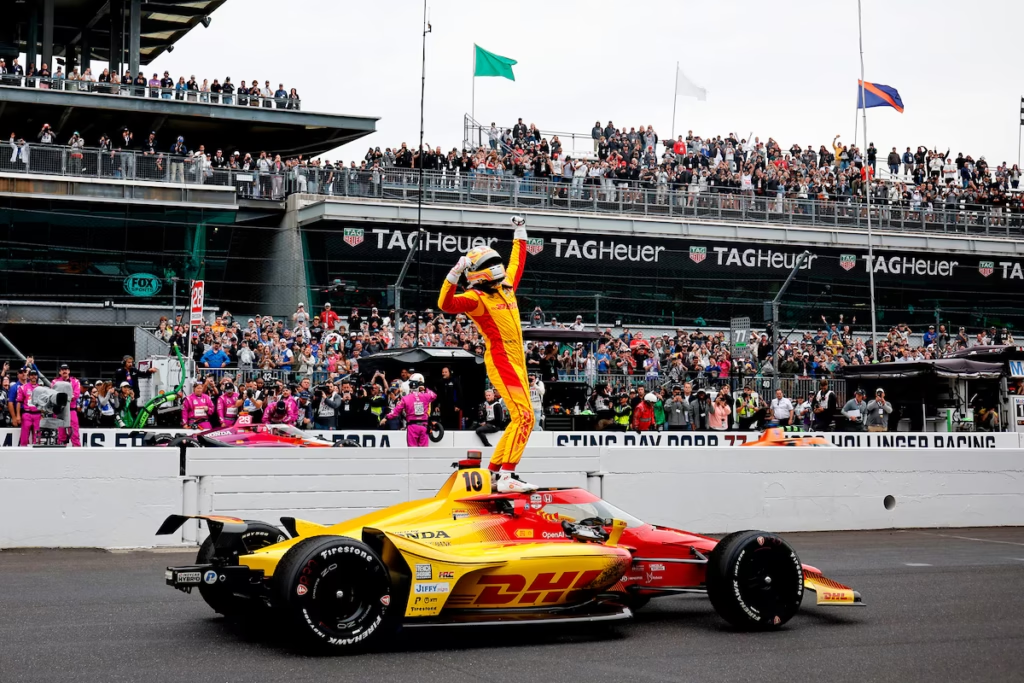
IndyCar (United States):
- Races on oval tracks (like the iconic Indianapolis 500), road courses, and street circuits
- Lacks power steering (more physically demanding than F1)
- Different technical regulations and extremely high speeds on ovals
- Often attracts drivers who couldn’t secure F1 seats or who prefer a different racing philosophy
Super Formula (Japan):
- Cars are nearly as fast as F1 in cornering performance
- Provides excellent preparation for drivers aiming to return to F1
- Has become a second home for experienced F1 drivers seeking to maintain sharp reflexes
Formula Mazda and Regional Single-Seater Series:
- More affordable pathways into open-wheel racing
- Important for developing talent in regions without direct F1 access
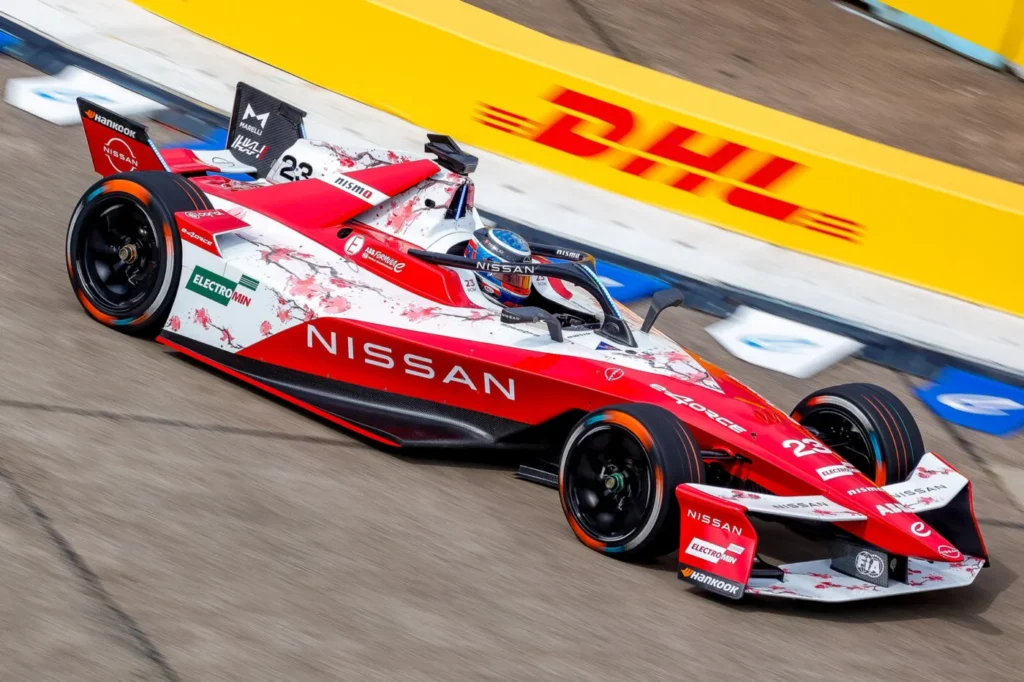
Formula E (Electric):
- The all-electric racing series competing in city centers worldwide
- Emphasizes energy management and sustainability
- Attracts drivers interested in the future of motorsport
The Long Road to Formula 1 — Sacrifice and Dreams
The Path: From Karting to the Grid
Most Formula 1 drivers begin their competitive careers in karting between the ages of 5 and 7. This is not casual recreation — it is the first step in a brutally competitive pyramid where only a handful will ever reach the pinnacle.
A typical progression:
- Karting (ages 5-14): Success in national and international karting championships determines who receives serious attention from academies and sponsors. Winning a World Karting Championship is often the first major milestone.
- Formula 4 (ages 14-17): The first single-seater experience. Young drivers must adapt to wings, slicks (specialized tires), and the technical demands of formula cars.
- Formula Regional (ages 16-19): Increased power and complexity. Races often last longer, and tyre management becomes critical for the first time.
- FIA Formula 3 (ages 17-20): International competition, often supporting F1 race weekends. This is where drivers become visible to F1 talent scouts and team managers.
- FIA Formula 2 (ages 18-21): All cars are identical, meaning talent alone determines success. Two-seater races and complex strategy make this the closest experience to F1 before reaching it.
- Formula 1 (age 20+): Only 20 seats exist worldwide. Only 1 in perhaps 5,000 karting drivers will ever start a Formula 1 race.
The True Cost of a Dream
Reaching Formula 1 requires extraordinary talent, but talent alone is insufficient. It also requires tremendous sacrifice and financial commitment.
Financial reality:
Getting a driver from karting to Formula 2 can cost between $5 million to $10 million over 10-15 years. This includes:
- Chassis and engine rentals
- Travel and accommodation across Europe
- Engineering and coaching staff
- Hospitality and logistics
- Sponsor activation (often unpaid work by the driver’s family)
Personal sacrifices:
- Most drivers move away from home at ages 12-14, leaving behind family, friends, and normal schooling.
- They sacrifice typical teenage experiences: school dances, casual friendships, and time with parents.
- They endure constant pressure: a single bad season can end sponsorship, leading to the end of their career.
- Mental health challenges are common, including anxiety, depression, and pressure-related burnout.
The psychological weight:
Young drivers must internalize an enormous responsibility. They understand that their families have mortgaged homes, invested life savings, and sacrificed normalcy for their dreams. The pressure to perform — starting at age 7 — shapes their psychology in profound ways.
“Fun Fact” — A Sobering Reality
There are more people who have traveled to outer space than people who have ever started a Formula 1 race.
As of 2025, approximately 900 people have reached space. Over the entire 75-year history of Formula 1, fewer than 900 drivers have started a Grand Prix. The rarity of even making one start in Formula 1 underscores just how exclusive the sport is.
The DNA of Modern Formula 1
The Technical Revolution: From Analog to Digital
One of the most hotly debated topics among F1 enthusiasts is the difference between the “analog” era and today’s “digital” age.
The Analog Era (1970s-1990s):
In this period, the driver was the absolute master of the machine. The car demanded:
- Manual gear shifting: Using an H-pattern gearbox, drivers had to take one hand off the wheel to shift while cornering at 200 km/h.
- No power steering: Drivers muscled the car around corners using pure physical strength.
- Mechanical grip: Tyre grip and chassis balance were everything. Without advanced aerodynamics, cars “slid” more, creating a dance between rubber and asphalt.
- Turbo lag: In the 1980s, engines could produce over 1,500 horsepower in qualifying trim. The lag between pressing the accelerator and the power arriving — sometimes 2-3 seconds — required superhuman reflexes.
- Unpredictability: Cars were less predictable, more dramatic, and more visceral.
The Modern Era (2010s-Present):
Modern F1 cars are the most sophisticated machines on Earth. But this sophistication comes with criticism:
Technical specifications of modern F1:
- Hybrid power units: 1.6L V6 turbocharged engines combined with complex energy recovery systems (ERS).
- Aerodynamic complexity: Wings, diffusers, and aero devices generate enormous downforce, but also create “dirty air” that makes following difficult.
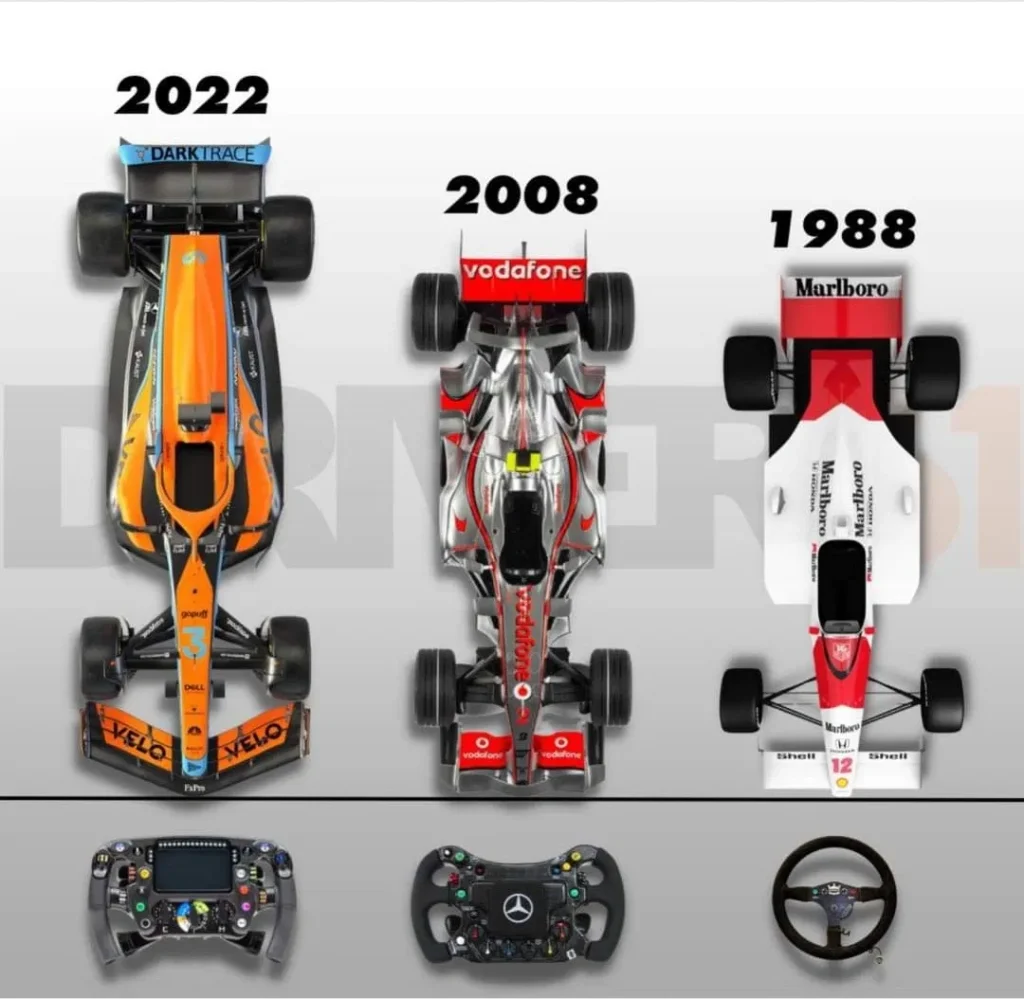
- Steering wheels: Modern steering wheels are engineering masterpieces with over 25 buttons, knobs, and switches for various functions.
- Energy management: Drivers constantly manage ERS deployment, fuel mixture, tyre temperature, and brake balance via radio instruction from engineers.
The perceived “problems” of modern cars:
- Weight: Modern cars weigh nearly 800 kg due to hybrid batteries, safety structures (the Halo), and complex electronics. Compare this to 1980s cars at around 540 kg.
- Size: Modern cars are nearly as long as a modern SUV — too big for tight circuits like Monaco.
- Complexity: Drivers are often called “engineers in the cockpit” because they must manage so many systems. Raw instinct and improvisation are less valued than data management.
- Dirty air: The complex aerodynamics mean cars lose significant grip when following another car closely, making overtaking difficult and racing processional.
- Sanitized experience: Some fans feel modern cars are too “controlled,” lacking the raw, unpredictable drama of earlier eras.
“An F1 Car’s Superpowers”
Fun fact: At extreme speeds, an F1 car generates so much downforce (aerodynamic grip) that, theoretically, it could drive upside down in a tunnel. The aerodynamic forces pressing it against the surface would exceed the car’s weight. Of course, no one has tested this!
Modern F1 cars can:
- Pull 5-6 G-forces in corners
- Brake from 200 km/h to 100 km/h in about 100 meters
- Corner at speeds that would roll a normal road car over
- Convert kinetic and thermal energy into electrical power via the ERS system
Classic vs. Modern — The Ongoing Debate
What Fans Loved About Analog Era Racing
Fans of the classic era cherish memories of:
- Raw sound: Engines that screamed at 18,000 RPM, turbos that whistled and wailed, and gearboxes that clattered.
- Driver visibility: Every correction the driver made was visible — sliding into corners, catching slides mid-turn, and muscling the car around tracks.
- Unpredictability: Mechanical failures, tyre degradation, and fuel strategy created surprises.
- Authenticity: The best driver won because they were the best, not because they managed data most effectively.
What Modern Racing Offers
The modern era brings:
- Safety: Modern cars protect drivers in ways unimaginable in the analog era. The Halo device alone saves lives regularly.
- Sustainability: Hybrid technology and sustainable fuels are preparing F1 for a carbon-conscious future.
- Efficiency: Modern engines produce as much power as 1980s turbos with a fraction of the fuel consumption.
- Competitive balance: Technical regulations ensure that no team can dominate indefinitely.
The Balance Challenge
The central challenge for F1 in the 2020s is balancing technological progress with emotional connection. The sport must:
- Continue improving safety
- Address climate change through sustainability
- Maintain the spectacle and drama that attract fans
- Keep cars that reward driver skill and bravery, not just data management
The Modern Challenges Facing Formula 1
The Sustainability Crisis
As the world moves toward net-zero emissions, F1 faces pressure to reduce its environmental footprint. The sport’s response includes:
Sustainable Fuels Initiative:
- By 2026, F1 cars will run on 100% “drop-in” sustainable fuel — a fuel made from renewable sources that fits into existing engine technology.
- This doesn’t require new carbon to be added to the atmosphere, marking a significant shift for a sport traditionally associated with fossil fuels.
Logistics Challenge:
- Surprisingly, the largest carbon footprint isn’t the cars themselves — it’s moving 10 teams, hundreds of personnel, and tons of equipment around the world 24 times per year.
- F1 is exploring virtual races, hybrid broadcasting, and more efficient travel.
Net Zero by 2030:
- F1 has committed to achieving net-zero carbon emissions by 2030 — an ambitious target that will reshape the sport.
The “Show” vs. The “Sport” Debate
The rise of the Netflix series Drive to Survive has brought millions of new fans to Formula 1. However, this popularity has created tension:
Positive outcomes:
- Global fanbase has grown dramatically
- Younger audiences are engaged
- Teams invest in content and storytelling
Criticisms from purists:
- The sport is becoming “too much like a reality show”
- Drama is sometimes created or exaggerated for entertainment
- Sprint races are seen as devaluing the main Grand Prix
- The focus on driver personalities sometimes overshadows competitive integrity
Overtaking and Racing Quality
A constant challenge: how do modern cars maintain close racing?
Modern F1 cars are incredibly fast, but the aerodynamic complexity makes them sensitive to “dirty air” — the turbulent air left behind a leading car. This makes overtaking difficult and racing processional.
Solutions being tested:
- Reducing overall aerodynamic dependency
- Increasing mechanical grip
- Changing wing configurations to reduce dirty air effects
- Modifying regulations to prioritize closer racing
Cost Control and Competitive Balance
Formula 1 is expensive. Teams spend $300 million to $500 million per year. This creates an imbalance:
- Rich teams (Mercedes, Red Bull, Ferrari) can afford the best technology
- Smaller teams struggle to compete
- The championship often becomes predictable due to resource disparity
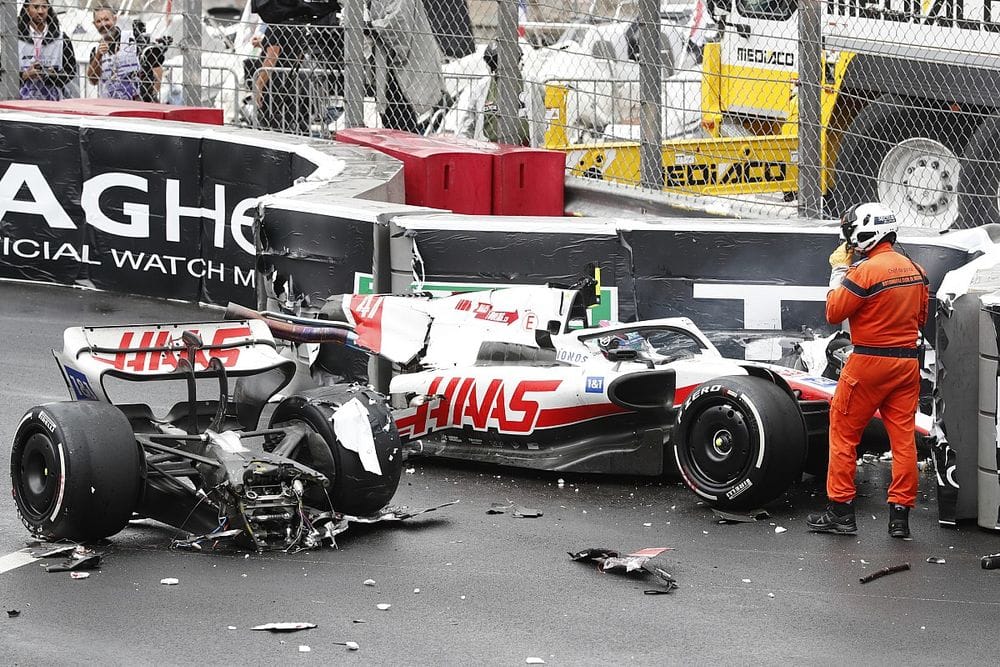
The FIA has implemented cost caps, but enforcement and competitive balance remain ongoing challenges.
Hungary’s Path to Formula 1 Glory
The Fifty-Year Absence
After the thrilling 1936 Hungarian Grand Prix, decades of political upheaval prevented Hungary from hosting world-class motorsport. The combination of:
- The outbreak of World War II
- Communist rule and the Iron Curtain
- Limited international sporting connections during the Cold War
…meant that Hungarian fans were cut off from Formula 1 for nearly 50 years.
The Breakthrough: 1986
In the 1980s, Bernie Ecclestone and F1 leadership sought to bring the sport to new frontiers. Racing behind the Iron Curtain would be a historic breakthrough — politically significant and economically valuable.
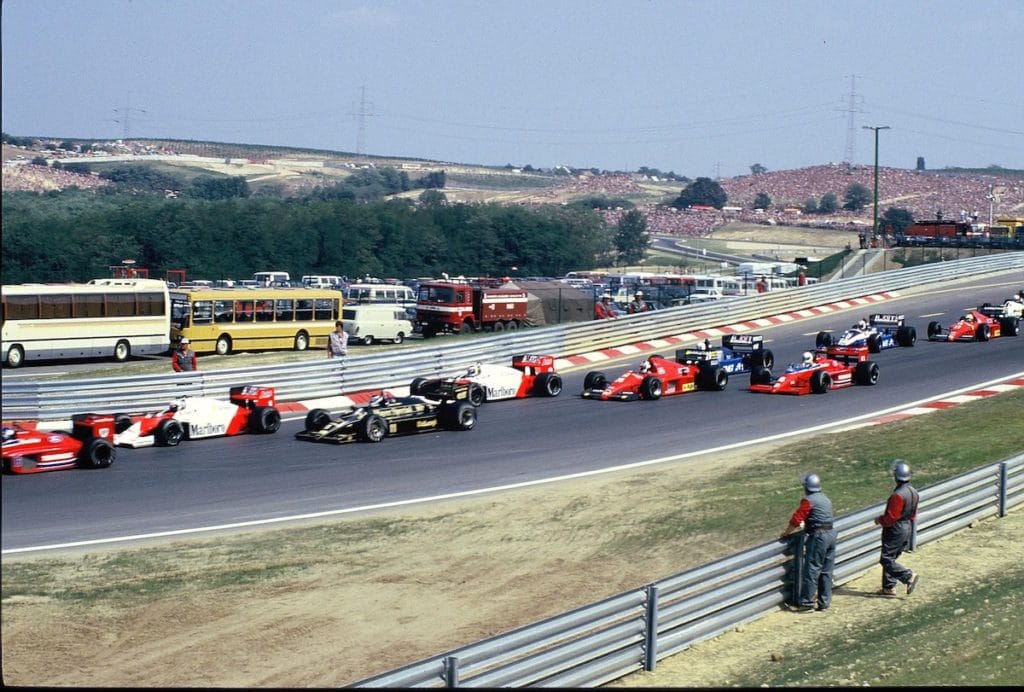
Hungary was chosen as the ideal host because:
- It had a demonstrated motorsport passion (remember 1936)
- The government was interested in modernization and international connections
- Hungary was seen as the most “open” communist country in the Eastern Bloc
The Hungaroring was built in record time:
- Construction began 1 October 1985
- The circuit was completed in just 8 months
- Opening in March 1986, this was one of the fastest-built F1 circuits in history
The first race — 24 March 1986:
- Over 200,000 spectators attended — a record that stood for years
- Nelson Piquet (Brabham-BMW) won the race
- Ayrton Senna was overtaken famously around the outside in one of the circuit’s classic passing moves
- The event was broadcast globally, symbolizing the breaking of the Iron Curtain through sport
Significance:
This race was more than a sporting event. It was a geopolitical statement — Formula 1, the symbol of capitalist competition and Western technology, arriving in a communist country. It represented hope, openness, and the power of sport to transcend political boundaries.
Hungarian Drivers in Formula 1
Hungary has produced remarkably few Formula 1 drivers compared to its population. However:
László Szisz:
- Won the very first Grand Prix in 1906 (at Le Mans)
- Hungarian-born, though he raced under various nationalities
- A historical figure in motorsport, though predating modern F1
Zsolt Baumgartner:
- The only Hungarian to score a Formula 1 World Championship point
- Competed for Minardi in 2004
- Finished 8th in the US Grand Prix at Indianapolis, scoring a single championship point
- A historic achievement for Hungarian motorsport, proving that drivers from the region could compete at the highest level
The rarity of Hungarian F1 drivers reflects the region’s late entry into the sport and the immense resources required to develop a driver to F1 level.
The Hungaroring — A Technical Masterpiece
The Character of the Track
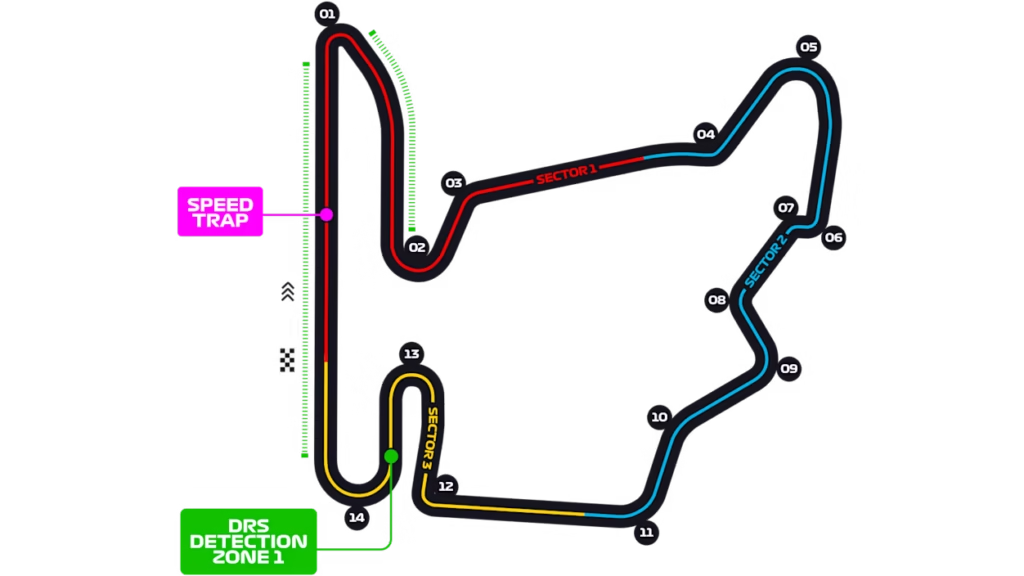
The Hungaroring is unique among modern F1 circuits. It’s often called “Monaco without the walls” — and for good reason.
Layout characteristics:
- Minimal straights: The circuit is an almost continuous series of corners with very few opportunities to build speed on the straights.
- Medium to slow-speed corners: The 4.381 km circuit features primarily medium and slow corners, with few high-speed sections.
- Narrow track width: The circuit is relatively narrow, limiting overtaking opportunities.
- Natural amphitheater: Built in a valley, approximately 80% of the track is visible from most grandstands — a unique feature that creates incredible spectator atmosphere.
Driving challenges:
- No margin for error: One mistake in a corner sequence can lose multiple positions
- Physical demands: The constant cornering offers drivers no rest, requiring exceptional fitness and concentration
- Tire sensitivity: The track is highly sensitive to tire temperatures and degradation
- Heat: The mid-summer race date and the valley location create extreme cockpit temperatures
Evolution of the Circuit
The Hungaroring has been modified several times to improve safety and racing:
1989 — First modification:
- A chicane was removed to create smoother flow
- Better overtaking opportunities were created
- The racing experience improved without fundamentally changing the circuit’s character
2003 — Major extension:
- The circuit was extended
- The first corner was reprofiled to encourage more passing moves
- Safety features were improved
Modern era improvements:
- Run-off areas expanded
- Barrier safety upgraded to modern standards
- Driver comfort facilities improved
Despite these changes, the Hungaroring has retained its essential character — a tight, technical, demanding circuit that rewards precision and punishes mistakes.
Hungaroring as a “Career Launcher”
The Hungaroring has a unique distinction: it has produced more first-time Formula 1 winners than almost any other circuit.
Why?
- Strategy matters more than machinery: On a track where overtaking is difficult, qualifying performance and race strategy are everything. Underdog teams with excellent strategy can win.
- Unpredictability: The tight nature of the circuit creates opportunities for surprise results.
- Fair competition: The lack of straightaway power negates any advantage large teams might have in top speed.
This is why the Hungaroring carries the nickname: “Where careers are born.”
A strong performance here catches the attention of larger teams and team principals. Young drivers have often used Hungarian victories as stepping stones to better equipment.
Hungary, the Hungaroring, and Motorsport Culture
The Passionate Fan Base
Since 1986, Hungary has developed an intensely passionate motorsport fan base. The Hungarian Grand Prix weekend has become:
- A regional festival with fans traveling from neighboring countries
- A gathering that feels more like a celebration than a sporting event
- An opportunity for Central and Eastern European fans to connect with global motorsport
The Hungarian Grand Prix atmosphere:
- Fans camp near the circuit for the entire weekend
- Team colors and national flags dominate the grandstands
- The energy is electric, particularly during the race
- Post-race celebrations often extend well into the evening
Supporting Categories and Talent Development
Beyond F1, the Hungaroring hosts:
- FIA Formula 3: Young drivers racing in support of the Grand Prix
- FIA Formula 2: The final step before F1, often featuring former race winners and future F1 stars
- Regional championships: Various junior formulas and national championships use the circuit
These supporting categories allow young Hungarian drivers to gain experience on a world-class circuit. A driver competing in Formula 3 at the Hungaroring gains the same track experience as F1 drivers — at a fraction of the cost and pressure.
Impact on Hungarian Society
The Hungarian Grand Prix has had cultural and educational impact:
- Engineering careers: The visibility of F1 technology has inspired young Hungarians to pursue careers in automotive engineering, aerodynamics, and motorsport-related fields.
- Global connection: The race provides a yearly connection to a global community of enthusiasts and professionals.
- National pride: For many Hungarians, the Grand Prix is a moment of national pride — proof that their country can host a world-class event.
- Economic impact: The race brings tourism, hospitality employment, and international attention to the region.
Open-Wheel Racing Beyond Formula 1
The Hungaroring’s Role in Junior Categories
Formula 1 drivers don’t simply appear on the grid. They develop through years of racing at lower formulas, often at the same circuits where they will later race in F1.
The Hungaroring plays this development role:
- Young drivers in Formula 3 race here, learning the track’s nuances
- Formula 2 drivers use this circuit to practice high-speed racing
- Regional and national championships occasionally feature the Hungaroring
For a young driver, getting a strong result at the Hungaroring can be a career catalyst:
- Talent scouts attend junior races here
- A podium finish attracts interest from larger teams
- The circuit’s difficulty means an impressive performance resonates with team managers
Alternative Open-Wheel Pathways
While the FIA ladder (F4 → F3 → F2 → F1) is the most common route, other pathways exist:
IndyCar graduates to F1:
- Some drivers transition from IndyCar to F1
- The different rules and techniques require adjustment
- Notable examples: Juan Pablo Montoya and Alex Rossi
Super Formula as a second home:
- Experienced F1 drivers sometimes race Super Formula to maintain skills
- Young Japanese drivers use this series as an alternative path to F1
Formula E and electric racing:
- Some drivers focus on electric racing exclusively
- This represents a different vision of motorsport’s future
Modern Formula 1 — Challenges and Opportunities
The Weight Problem
Modern F1 cars are heavier than many fans prefer. Current regulations mandate cars around 800 kg in weight. In comparison:
- 1970s F1 cars: ~350 kg
- 1980s F1 cars: ~540 kg
- 1990s F1 cars: ~600 kg
- 2000s F1 cars: ~700 kg
- Current F1 cars: ~800 kg
Why the increase?
- Hybrid systems: The battery and electrical motor system adds significant weight
- Safety structures: The Halo and modern cockpit protection add weight
- Fuel system capacity: Hybrid cars carry more energy, requiring larger tanks
- Aerodynamic components: Modern aero devices are heavier than older generations
The consequences:
- Reduced agility in some corners
- Increased stress on tires
- Higher fuel consumption rates
- Complaints that the cars feel “heavy and lumbering” compared to historic machines
For 2026, regulations will attempt to reduce weight by focusing on hybrid efficiency and aerodynamic optimization.
The Steering Wheel Problem
A modern F1 steering wheel is a marvel of engineering — and a source of complexity that some argue has gone too far.
What’s on a modern steering wheel?
- Analog controls: Steering (obviously), brake bias adjustment
- Digital switches: ERS deployment mode, fuel mixture, DRS activation, gear selection
- Rotary knobs: Suspension adjustment (stiffness, height), differential settings
- Display screen: Real-time telemetry, lap times, fuel calculations
- Vibration feedback: Haptic warnings for tire grip, engine status
A driver must manage 25+ functions while racing at 300+ km/h. This has led to criticism:
- Radio commands: Drivers often need engineer guidance on what to adjust
- Cognitive load: Managing all these systems leaves less mental energy for pure driving
- Reduced driver input: The optimization is often left to engineers analyzing data
Compare this to classic F1 where the driver had a steering wheel, three pedals, and a gear stick — and had to manage everything through feel and instinct.
The Dirty Air Problem (and Potential Solutions)
The complex aerodynamics of modern F1 create a significant problem: dirty air.
What is dirty air?
When a car moves through the air, it disrupts the airflow behind it. A following car loses aerodynamic grip because it’s driving through turbulent, disrupted air rather than clean air. This aerodynamic penalty is so severe that:
- Following a car can mean losing 0.5-1.5 seconds per lap
- Overtaking is extremely difficult unless the pursuing car is significantly faster
- Racing becomes processional and dull
Potential solutions being tested:
- Active aerodynamics: Adjustable wing angles that change mid-corner
- Reduced drag: Making cars less dependent on aerodynamic grip
- Increased mechanical grip: Wider, stickier tires
- Revised regulations: Aerodynamic rules designed to reduce dirty air effects
For the 2026 regulation change, F1 is attempting to reduce aerodynamic dependency and improve racing quality.
The Future of Formula 1
The 2026 Regulation Reset
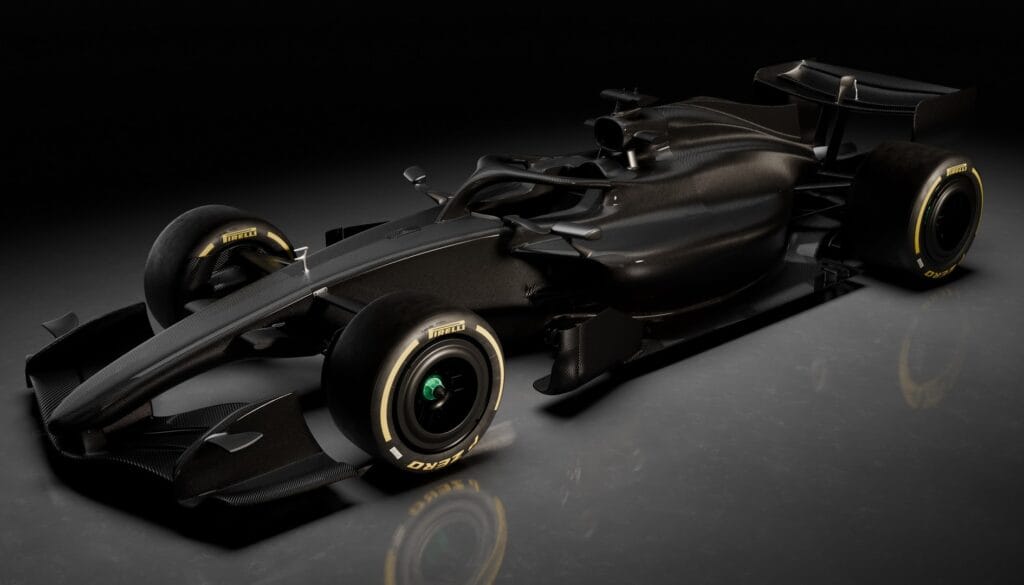
Formula 1 enters a new era with the 2026 regulations. Key changes include:
Power unit revolution:
- Engines will be 50% internal combustion, 50% electric
- No more difference between hybrid and pure electric — all cars will be hybrid
- Potential for alternative fuels and sustainable power sources
Chassis improvements:
- Cars will be lighter (targeting reduction from 800 kg)
- Cars will be smaller (shorter, narrower, lower)
- Aerodynamic redesign to improve racing quality
Technological innovation:
- Active aerodynamics: Wings that change shape during corners
- AI integration: Teams will use artificial intelligence for advanced simulations
- Sustainable materials: Increased use of carbon-neutral and recyclable materials
The Evolution of Driver Training and Selection
The future of driver development may include:
- AI-assisted training: Artificial intelligence analyzing training data to optimize driver development
- Diversity initiatives: Efforts to recruit drivers from underrepresented regions and backgrounds
- Mental health support: Recognition that psychological strength is as important as physical fitness
- Esports integration: Top sim racing drivers potentially creating a pathway to real-world racing
The Hungaroring’s Future
The Hungaroring is likely to:
- Adapt to new regulations: The 2026 cars may require circuit modifications for safety or racing quality
- Continue as a regional anchor: It will remain the premier racing venue for Central and Eastern Europe
- Embrace sustainability: Track operations will become more carbon-neutral
- Maintain its character: Despite changes, the tight, technical layout will remain challenging for drivers
Why Formula 1 Matters — And Why the Hungarian Grand Prix Especially
Formula 1 as Ultimate Human Performance
Formula 1 is more than a sport. It represents:
- Human courage: Drivers regularly perform at the extreme edge of human capability
- Engineering mastery: The cars are engineering masterpieces, combining thousands of innovations
- Global connection: Fans worldwide unite in their passion for racing
- The eternal pursuit of speed: A fundamental human desire to go faster than anyone else
The Hungaroring’s Special Significance
The Hungarian Grand Prix holds a unique place in the F1 calendar:
- Historical weight: It represents the breaking of the Iron Curtain through sport
- Regional importance: It’s the primary F1 race for Central and Eastern European fans
- Technical purity: The circuit rewards pure driving skill and strategy more than raw power
- Accessibility: For many fans, the Hungaroring is a place where F1 feels “closest” and most alive
The Hungaroring as a Metaphor
In many ways, the Hungaroring represents the essence of Formula 1:
- Tight and demanding: Success requires precision and consistency
- No room for error: Mistakes are immediately punished
- Fair competition: All teams face the same challenge
- Rewarding excellence: The best drivers and strategies prevail
Conclusion: The Enduring Spirit of Formula 1
Formula 1 is not just about lap times. It’s about:
- Dreams that start in childhood and require two decades of sacrifice to realize
- Risks taken at speeds where the margin between glory and tragedy is razor-thin
- Nations, cultures, and generations united by the simple desire to watch the fastest drivers in the fastest cars
- Progress and innovation pushing the boundaries of what’s mechanically and humanly possible
The Hungarian Grand Prix, held every July at the Hungaroring, is a yearly reminder of all of this. For those who attend, it’s not just a race — it’s a participation in a living tradition, a connection to a global community, and a celebration of human ambition.
Final thought to remember:
The Hungaroring was built in eight months, beginning in October 1985, and opened with its first Formula 1 race in March 1986. Every year since then, when the lights go out at the start of the Hungarian Grand Prix, it’s a reminder of motorsport history and rapid ambition.
From the ashes of the 1936 race, from fifty years of absence, from a political revolution that opened borders — Hungary returned to Formula 1. And every lap at the Hungaroring proves that some dreams, once kindled, never truly die.
If you’d like to explore more topics or to access the required quiz for purchasing your raffle ticket, visit our main Quiz & Studies page.
Quiz
Each study material comes with a short practice quiz at the end. These quizzes are completely optional and designed to help you review what you’ve learned and prepare for the Big Quiz.
💡 Use them to test your knowledge in a fun, low-pressure way – no email or name required.
We’re always improving and updating our content. If you spot anything that seems off, don’t hesitate to reach out – your feedback truly matters to us!
👉 Ready to test yourself? Start the Practice Quiz below:
#1. What does the word “formula” mean in motorsport?
#2. What made the 1986 Hungarian Grand Prix historically important?
#3. When did the first official Formula 1 World Championship season begin?
#4. Where was the first Formula 1 World Championship race held?
#5. What unique visual feature does the Hungaroring offer spectators?
Results

Lights out and away you go! 🏁
Nice driving — you’ve got the knowledge to stay on the racing line.
The Formation Lap is starting soon, now sit back and wait for the green light! 🚦

Yellow flag! 🚩
Looks like you ran wide this time — but no worries.
Review the study material, refuel your knowledge, and come back stronger on the next lap! 🏎️💨