
The Alchemist by Paulo Coelho: A Spiritual Classic on Destiny, Transformation, and Personal Legend
The Alchemist (O Alquimista) by Paulo Coelho stands as one of the most extraordinary literary phenomena of the modern era, transforming from a modest 900-copy first edition in 1988 into a global bestseller with over 150 million copies sold worldwide. This deceptively simple tale of Santiago, an Andalusian shepherd boy who embarks on a journey from Spain to the Egyptian pyramids in search of treasure, has transcended cultural, linguistic, and religious boundaries to become one of the most translated books by a living author, available in more than 80 languages and published in over 170 countries.
The novel’s universal appeal lies not merely in its accessible narrative structure, but in its profound exploration of themes that resonate across all human cultures: the pursuit of one’s dreams, the importance of listening to one’s heart, the interconnectedness of all creation, and the transformative power of following what Coelho terms one’s “Personal Legend”. Born from the author’s own spiritual crisis and quest for meaning following his transformative pilgrimage to Santiago de Compostela in 1986, The Alchemist has evolved into more than a book—it has become a modern spiritual guide that continues to inspire millions of readers to pursue their dreams and seek deeper meaning in their lives.
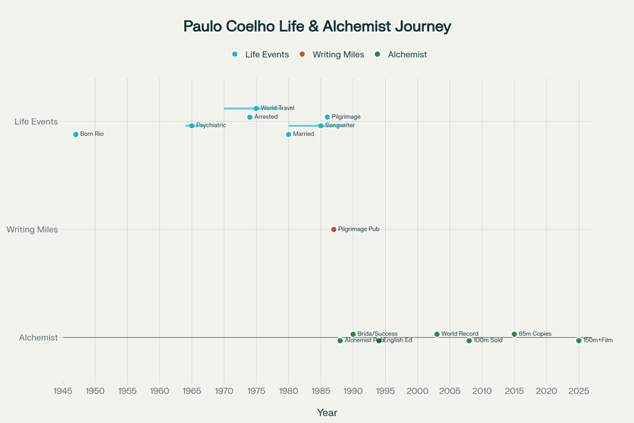
Paulo Coelho’s Life Before The Alchemist: Rebellion, Spiritual Crisis, and Transformation
Rebellious Youth and Early Influences on The Alchemist
Paulo Coelho de Souza was born on August 24, 1947, in Rio de Janeiro, Brazil, into a middle-class Catholic family where his father worked as an engineer and his mother as a housewife. From an early age, Coelho displayed characteristics that would define his entire life: a deep spiritual curiosity, creative ambitions that clashed with conventional expectations, and a rebellious nature that consistently challenged authority. At age seven, while attending a Jesuit school in Rio de Janeiro, he won his first literary recognition in a school poetry competition, foreshadowing his future calling as a writer.

However, Coelho’s artistic aspirations and introverted personality alarmed his traditionally minded parents, who viewed his behavior as psychologically disturbed. When seventeen-year-old Paulo declared his intention to become a writer, his mother responded dismissively: “My dear, your father is an engineer. He’s a logical, reasonable man with a very clear vision of the world. Do you actually know what it means to be a writer?”. This rejection of his dreams led to a series of traumatic events that would profoundly shape his worldview and later literary work.
Between 1964 and 1967, Coelho’s parents had him committed to a psychiatric institution three times, subjecting him to electroconvulsive therapy in an attempt to “cure” his creative inclinations and rebellious behavior. Coelho later reflected on this period with remarkable forgiveness: “It wasn’t that they wanted to hurt me, but they didn’t know what to do… They did not do that to destroy me, they did that to save me”. These experiences of institutionalization and forced conformity would later inform his novel “Veronika Decides to Die” and contribute to his lifelong advocacy for individual freedom and the pursuit of personal dreams.
How Coelho’s Hippie Years Shaped Themes in The Alchemist
Abandoning his parents’ wishes for him to study law after just one year, Coelho embraced the countercultural movement of the late 1960s and early 1970s. He spent two years traveling through South America, North Africa, Mexico, and Europe, experimenting with drugs and alternative lifestyles while searching for spiritual meaning and authentic experience. This period of wandering and experimentation reflected the same restless spirit that would later characterize Santiago’s journey in The Alchemist.
Returning to Brazil in the early 1970s, Coelho found his creative outlet in music, working as a lyricist for prominent Brazilian artists including Elis Regina, Rita Lee, and most significantly, rock icon Raul Seixas. His collaboration with Seixas produced some of Brazil’s most memorable songs and introduced Coelho to esoteric and magical themes that would later permeate his literary work. However, his involvement in Brazil’s countercultural movement during the military dictatorship proved dangerous—in 1974, he was arrested for “subversive activities” and tortured by the ruling military government, who viewed his lyrics as left-wing propaganda threatening to their authority.
This experience of political persecution and physical torture left deep psychological scars but also reinforced Coelho’s commitment to artistic freedom and his belief in the transformative power of creative expression. The contrast between his creative aspirations and the brutal realities of political oppression created a tension that would later manifest in his writing as a persistent theme of individuals struggling against forces that suppress their authentic selves.
The Camino de Santiago and Its Role in Inspiring The Alchemist
The 1980s marked a period of material success but spiritual emptiness for Coelho. Working as a music industry executive, he achieved financial stability and professional recognition, yet felt increasingly disconnected from his deeper purpose. This internal conflict intensified until a chance encounter in an Amsterdam café changed the trajectory of his life: a stranger advised him to undertake the traditional Roman Catholic pilgrimage to Santiago de Compostela in northern Spain.
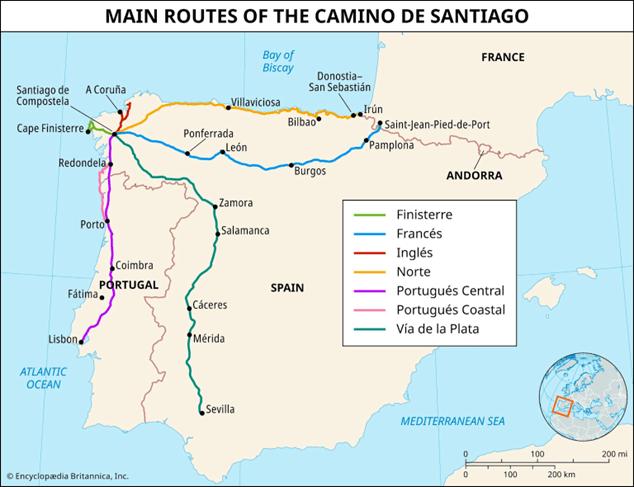
In 1986, at age 39, Coelho walked the 500-mile Camino de Santiago, a medieval pilgrimage route that had attracted spiritual seekers for over a thousand years. The physical and spiritual challenges of this journey—walking through remote Spanish countryside, sleeping in primitive accommodations, and confronting his own fears and limitations—triggered what he described as a profound spiritual awakening. He later explained: “[In 1986], I was very happy in the things I was doing. I was working, I had a person whom I loved, I had money, but I was not fulfilling my dream. My dream was, and still is, to be a writer”.

The pilgrimage experience provided Coelho with the clarity and courage to abandon his lucrative career in music and dedicate himself entirely to writing. More importantly, it gave him direct experiential knowledge of the spiritual journey that would become the foundation for all his subsequent literary work. The transformation was so profound that he wrote about it immediately upon his return, producing “The Pilgrimage” (O Diário de Um Mago) in 1987, which became his first successful book and established his reputation in Brazil.
How The Alchemist Was Created: A Book “Written in the Soul
Why Coelho Wrote The Alchemist in Two Weeks
The Alchemist emerged from Coelho’s deepest spiritual insights and creative instincts in 1988, written in just two weeks during a period of intense inspiration. Coelho later explained that he was able to write the book so quickly “because it was already written in my soul”—suggesting that the story represented not just a creative work but a crystallization of his own life experiences and spiritual understanding. The speed of composition reflected his complete absorption in the material and his confidence that he was channeling something greater than mere literary ambition.
The novel’s genesis was itself steeped in the magical thinking that characterizes much of Coelho’s approach to life and creativity. Before beginning any new book, Coelho has maintained a ritual of looking for a white feather as a divine sign that he should proceed with writing. When he spotted a white feather in a shop window, he interpreted this as confirmation that he should write The Alchemist, and he began that very day. This integration of mystical practices with creative work reflects the same spiritual approach that permeates the novel itself.
Symbolic Framework in The Alchemist: Omens, Alchemy, Destiny
The Alchemist employs a deceptively simple narrative structure that disguises its sophisticated exploration of universal spiritual themes. The story follows Santiago, a young Andalusian shepherd, who abandons his comfortable life after receiving a recurring dream about finding treasure near the Egyptian pyramids. This basic quest narrative provides a framework for exploring profound questions about destiny, purpose, and the relationship between material and spiritual wealth.
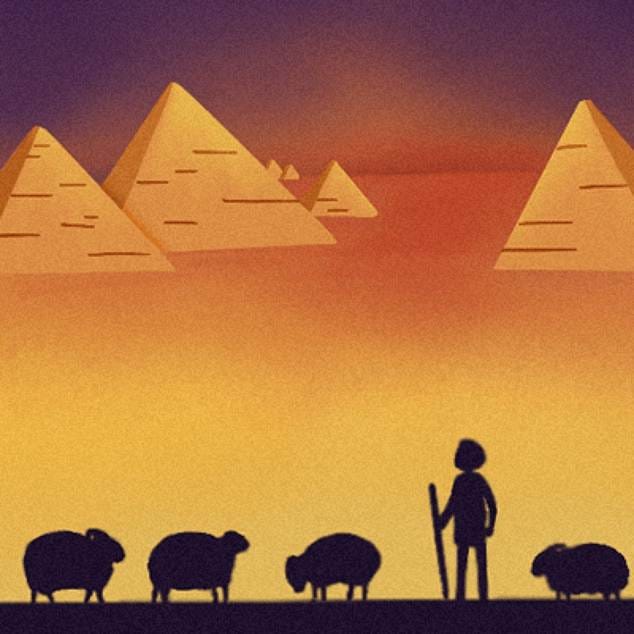
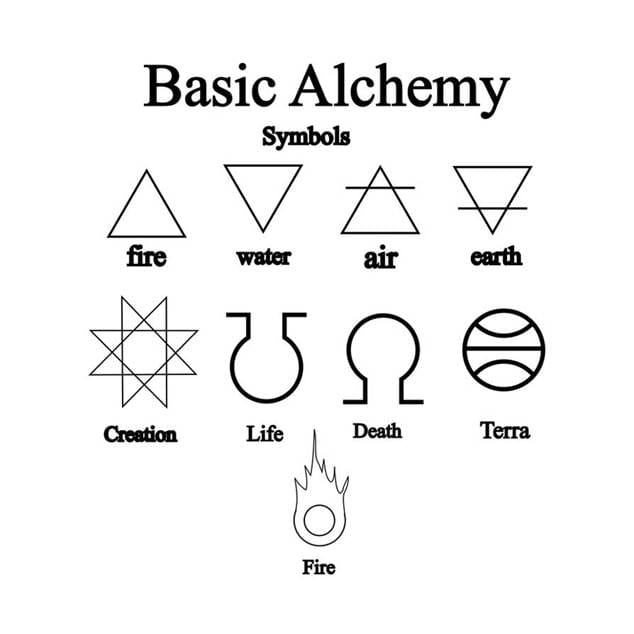
The novel’s symbolic density operates on multiple levels simultaneously. On its surface, it functions as an adventure story suitable for readers of all ages, but its deeper meanings encompass alchemical transformation, spiritual awakening, psychological individuation, and philosophical inquiry into the nature of reality. Coelho’s use of alchemical symbolism—the transformation of base metals into gold—serves as a metaphor for the spiritual transformation of the human soul through the pursuit of one’s deepest dreams and authentic purpose.

Santiago’s Journey as a Model of the Personal Legend
The novel’s central philosophical concept, the “Personal Legend,” represents Coelho’s synthesis of various spiritual and psychological traditions into a accessible framework for understanding human purpose and potential. Melchizedek, the King of Salem, explains to Santiago that “to realize one’s destiny is a person’s only real obligation,” introducing the idea that each individual possesses a unique purpose that the universe actively supports. This concept draws from diverse sources including Jungian psychology, Christian mysticism, Islamic Sufism, and New Age spirituality, creating a universal language for discussing spiritual development.
The Personal Legend is presented not as a predetermined fate but as a potential that requires active pursuit and continuous choice. Santiago must repeatedly decide whether to continue his journey or accept comfortable alternatives, reflecting Coelho’s belief that spiritual growth requires persistent commitment to one’s deepest aspirations even in the face of obstacles and uncertainties. This emphasis on individual choice and responsibility resonates with contemporary audiences seeking meaning and direction in their own lives.
The Personal Legend in The Alchemist: Meaning and Origins
The Language of the World: Universal Connection in The Alchemist
The Alchemist introduces the concept of a “language of the world” that transcends verbal communication and connects all created beings through a universal consciousness that Coelho terms the “Soul of the World”. Santiago learns to communicate with the wind, the desert, and the sun, discovering that everything in creation participates in a cosmic dialogue that reveals the interconnectedness of all existence. This mystical concept draws from various spiritual traditions, including Sufism, Christian mysticism, and indigenous shamanism, while remaining accessible to readers regardless of their religious background.
The Soul of the World represents a divine force that actively assists individuals in pursuing their Personal Legends, manifesting through synchronicities, omens, and seemingly coincidental encounters. When Santiago commits fully to his journey, he discovers that “when you want something, all the universe conspires to help you achieve it”—perhaps the novel’s most famous and frequently quoted insight. This idea challenges materialistic worldviews by suggesting that reality possesses an inherent intelligence and purpose that responds to human intention and desire.
Love and Fatima: The Spiritual Test in The Alchemist
Santiago’s encounter with Fatima at the Al-Fayoum oasis introduces the novel’s most complex philosophical challenge: the relationship between love and Personal Legend fulfillment. Initially, Santiago considers abandoning his journey to the pyramids in order to remain with Fatima, whom he recognizes as his true love. This dilemma reflects a universal human experience—the tension between personal relationships and individual destiny—that has no simple resolution.
The novel’s handling of this conflict reveals Coelho’s sophisticated understanding of spiritual development. Rather than dismissing romantic love as an obstacle to spiritual growth, The Alchemist suggests that authentic love actually supports and encourages the beloved’s Personal Legend rather than constraining it. Fatima tells Santiago: “If I am really a part of your dream, you’ll come back one day”. This response demonstrates the novel’s belief that true love is characterized by faith, patience, and the willingness to support another person’s highest development even when it requires separation.
Fear as the Main Obstacle to Destiny in The Alchemist
Throughout Santiago’s journey, fear emerges as the primary obstacle to Personal Legend fulfillment, manifesting in various forms including fear of failure, fear of success, fear of the unknown, and fear of loss. The novel presents fear not as something to be eliminated but as a natural part of the human experience that must be acknowledged and transcended through courage and faith. Santiago must overcome his fear when he is robbed in Tangier, when he considers returning to his comfortable life as a shepherd, and when he must transform himself into the wind to save his life.
The Alchemist suggests that obstacles serve a crucial function in spiritual development by testing the sincerity of one’s commitment to their Personal Legend. The crystal merchant, who abandoned his own dream of making the pilgrimage to Mecca, serves as a cautionary example of someone who allowed fear to prevent him from pursuing his deepest aspirations. Through this character, Coelho illustrates how the failure to pursue one’s Personal Legend leads to regret, spiritual stagnation, and a life of “what if” rather than authentic fulfillment.
The Treasure’s True Nature
The novel’s conclusion reveals that Santiago’s treasure lies buried beneath the very tree where he first dreamed of it, suggesting that what we seek is often closer to home than we imagine. However, this apparent circularity serves a deeper philosophical purpose: Santiago needed to undertake his journey not to find the physical treasure but to develop the wisdom, courage, and spiritual insight necessary to recognize true wealth. Without his experiences in Morocco, his time with the crystal merchant, his love for Fatima, and his encounter with the alchemist, Santiago would have remained a simple shepherd unable to perceive the treasure’s significance.
This revelation embodies the novel’s central teaching that the journey itself transforms the traveler, making them capable of receiving what they originally sought. The treasure’s location suggests that fulfillment comes not from external acquisition but from internal development—a fundamentally alchemical insight about the transformation of consciousness rather than material circumstances. Santiago returns to Andalusia as a different person, enriched not merely with gold but with the wisdom and self-knowledge that constitute true spiritual wealth.
The Global Rise of The Alchemist: Publication, Sales, and Cultural Impact
Why The Alchemist Initially Failed to Sell
The Alchemist’s path to global success began inauspiciously in 1988 when a small Brazilian publisher, convinced that the book would have limited appeal, printed only 900 copies and told Coelho, “This title will never sell more than 900 copies”. When this modest first edition failed to generate significant sales, the publisher declined to reprint, allowing Coelho to retain the rights to his work. This initial rejection might have discouraged a less determined author, but Coelho’s faith in his book remained unshakeable—reflecting the same persistence that he advocated for pursuing one’s Personal Legend.
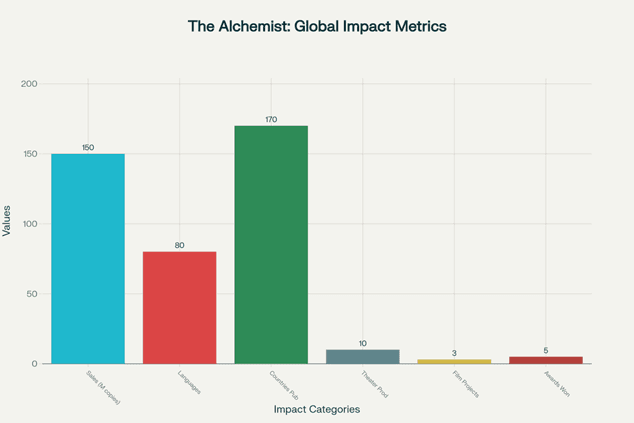
The book’s fortunes changed dramatically with the publication of Coelho’s next novel, “Brida,” in 1990 by a larger Brazilian publisher. The success of “Brida” drew renewed attention to The Alchemist, which was reprinted and quickly climbed Brazil’s bestseller lists. Within two years, Coelho’s two books had sold 500,000 copies in Brazil—a record-breaking achievement that no previous Brazilian author had matched. This domestic success provided the foundation for international expansion and demonstrated the book’s potential to reach beyond its original cultural context.
How The Alchemist Became a Worldwide Success: Translations and Breakthrough
The Alchemist’s transformation from Brazilian bestseller to global phenomenon began in 1994 when HarperCollins commissioned an English translation and printed 50,000 copies for the American market. However, Coelho’s approach to international publication was notably unconventional and reflected his commitment to cultural authenticity over commercial expedience. Rather than simply licensing translation rights to the highest bidder, he insisted on working with local publishers in each new country, personally involving himself in setting appropriate prices for different markets and even providing free digital versions to increase accessibility.
This grassroots approach to international expansion proved remarkably effective, as The Alchemist began achieving bestseller status in country after country throughout the 1990s and 2000s. Coelho’s willingness to tour extensively, promoting his book through personal appearances, readings, and media interviews, created a direct connection between author and readers that transcended cultural boundaries. His strategy of offering pirated versions of his own books in countries like Russia, where intellectual property protection was limited, demonstrated his priority for reaching readers over maximizing profits.
The Alchemist’s Record-Breaking Achievements and Worldwide Recognition
By 2003, The Alchemist had achieved sufficient international recognition to earn Coelho the Guinness World Record for “The Most Translations of a Single Title Signed in One Sitting” when he signed 53 different language editions at the Frankfurt Book Fair. This milestone reflected not only the book’s commercial success but its unprecedented cultural reach across linguistic and national boundaries. The novel’s translation into languages ranging from major international tongues to regional dialects demonstrated its universal appeal and Coelho’s commitment to making his message accessible to readers worldwide.
In 2008, Coelho celebrated another significant milestone when his total book sales reached 100 million copies—a achievement marked by a celebration in Frankfurt that acknowledged his transformation from unknown Brazilian author to international literary phenomenon. The Alchemist itself had contributed significantly to this total, with over 65 million copies sold by 2021, making it one of only nine books in history to exceed 100 million copies. These numbers placed Coelho among the most successful authors of all time, alongside literary giants like Charles Dickens and J.K. Rowling.
Cultural Impact of The Alchemist: Global Reception and Cross-Cultural Resonance
Why The Alchemist Resonates Across Cultures
The Alchemist’s extraordinary global success reflects its ability to speak to universal human experiences that transcend cultural, religious, and linguistic differences. Unlike many bestsellers that achieve popularity within specific cultural contexts, Coelho’s novel has found enthusiastic audiences in countries as diverse as Japan and Brazil, Germany and India, demonstrating its capacity to communicate fundamental truths about human nature and spiritual aspiration. This cross-cultural appeal stems partly from Coelho’s deliberate use of archetypal symbols and universal themes that resonate across different cultural traditions.
The book’s spiritual message has proven particularly resonant in cultures undergoing rapid modernization and social change, where traditional sources of meaning and identity are being challenged by globalization and technological advancement. Readers in countries experiencing economic development and cultural transition have found in Santiago’s journey a framework for navigating their own transformations while maintaining connection to deeper spiritual values. This relevance to contemporary global conditions has contributed significantly to the book’s sustained popularity across multiple decades.
Religion and Universal Spirituality in The Alchemist
The Alchemist’s integration of elements from Christianity, Islam, Judaism, and various mystical traditions has made it a significant text within the New Age spiritual movement while simultaneously drawing criticism from traditional religious authorities. Coelho’s syncretic approach to spirituality—blending Christian mysticism, Sufi teachings, alchemical symbolism, and contemporary psychology—reflects the eclectic spiritual seeking that characterizes much of contemporary religious life. The novel’s suggestion that all religions contain similar essential truths appeals to readers seeking spiritual meaning outside conventional religious institutions.
However, this same universalistic approach has generated controversy within traditional religious communities. Some Catholic critics have argued that Coelho’s integration of non-Christian spiritual elements contradicts fundamental Christian doctrines, while Islamic scholars have questioned his appropriation of Sufi concepts without proper grounding in Islamic theology. These critiques reflect broader tensions between traditional religious authority and individualistic spiritual seeking that characterize contemporary religious discourse.
Critics vs. Readers: The Debate Over The Alchemist’s Literary Value
The relationship between The Alchemist’s commercial success and its critical reception reveals significant tensions within contemporary literary culture. While the novel has achieved unprecedented global sales and reader enthusiasm, its reception among literary critics and academic scholars has been notably mixed, with many dismissing it as “more self-help than literature”. This criticism reflects broader debates about the distinction between popular and literary fiction, and the criteria by which literary value should be assessed.
Critics have particularly targeted what they perceive as the novel’s simplistic philosophical messages, formulaic narrative structure, and reliance on spiritual clichés rather than genuine insight. The Guardian’s categorization of the book as children’s literature reflects a dismissive attitude toward its accessible style and optimistic worldview. However, defenders argue that this criticism reflects cultural bias against popular literature and fails to acknowledge the book’s sophisticated use of symbolic and allegorical techniques. The persistent gap between critical dismissal and reader enthusiasm suggests fundamental disagreements about the purpose and value of literature in contemporary culture.
Adaptations of The Alchemist: Theater, Film, and Modern Interpretations
Why Adapting The Alchemist to Film Is Difficult
The Alchemist’s theatrical adaptations have provided opportunities for creative interpretation of its visual and symbolic elements while preserving its essential spiritual message. The most notable stage adaptation premiered in London in 2002, featuring innovative staging techniques that represented Santiago’s journey through symbolic landscapes and archetypal encounters. These theatrical versions have demonstrated the story’s adaptability to different artistic media while revealing new dimensions of meaning through live performance and audience interaction.
Regional theater companies worldwide have created culturally specific interpretations of the story, adapting its universal themes to reflect local spiritual traditions and cultural contexts. These adaptations have included versions incorporating indigenous American spiritual practices, Asian meditation traditions, and African storytelling techniques, demonstrating the story’s flexibility and universal applicability. The success of these diverse interpretations reinforces the novel’s cross-cultural appeal while revealing how its archetypal structure can accommodate varied cultural expressions.
Theater and Multimedia Adaptations of The Alchemist
Despite numerous attempts over more than two decades, The Alchemist has proven surprisingly difficult to adapt successfully for film, with multiple high-profile projects failing to reach production. Warner Bros. initially acquired the film rights in 2003 but abandoned the project when their proposed script emphasized military action and special effects rather than the story’s spiritual and psychological dimensions. Coelho reportedly offered $2 million to buy back the rights rather than allow a misrepresentative adaptation to be produced.
Subsequent attempts by the Harvey Weinstein Company and later by Will Smith’s production company have similarly struggled to translate the book’s internal, contemplative nature into cinema’s visual and external medium. The 2021 announcement that Will Smith would produce and star in an adaptation generated renewed optimism, with filming scheduled to begin in Morocco with an international cast. However, as of 2025, the project remains in development with director Philip Barantini now attached to helm the adaptation for Legendary Entertainment. These production challenges reflect the fundamental difficulty of adapting a work whose power lies in internal transformation and spiritual insight rather than external action and conflict.
Educational and Therapeutic Applications
The Alchemist’s accessible presentation of complex philosophical and psychological concepts has made it valuable in educational settings worldwide, where teachers use it to introduce students to topics including comparative religion, mythology, psychology, and philosophy. The novel’s integration of Eastern and Western spiritual traditions provides a framework for discussing cultural differences and similarities, while its emphasis on individual purpose and self-realization resonates with adolescent students exploring their own identity and future directions.
Mental health professionals and life coaches have increasingly incorporated The Alchemist into therapeutic practices, using its narrative structure and symbolic framework to help clients explore their own life goals and obstacles. The concept of the Personal Legend provides a non-clinical vocabulary for discussing personal purpose and meaning, while the novel’s treatment of fear and obstacles offers concrete examples of psychological challenges and their resolution. This therapeutic application reflects the book’s practical value as a tool for personal development beyond its literary and entertainment functions.
Why The Alchemist Still Matters: Contemporary Relevance and Significance
Digital-Age Spirituality and The Alchemist
In an era characterized by technological acceleration, social media distraction, and material abundance coupled with spiritual emptiness, The Alchemist’s message about following one’s heart and pursuing authentic purpose has gained renewed relevance. The novel’s emphasis on slowing down, paying attention to omens and synchronicities, and prioritizing spiritual development over material accumulation provides a counterpoint to contemporary culture’s emphasis on productivity, efficiency, and external success. Young readers, in particular, have found in Santiago’s journey a framework for resisting societal pressure to pursue conventional career paths in favor of more personally meaningful directions.
The book’s integration of mystical and practical approaches to life decision-making resonates with contemporary interests in mindfulness, meditation, and alternative spirituality. The concept of the Soul of the World aligns with growing scientific understanding of ecological interconnectedness and systems thinking, while the novel’s emphasis on personal transformation reflects contemporary psychology’s focus on human potential and self-actualization. These connections between ancient wisdom and contemporary insights contribute to the book’s continuing relevance for new generations of readers.
Entrepreneurship Lessons Drawn from The Alchemist
The Alchemist’s themes of risk-taking, persistence, and following one’s vision have found particular resonance within entrepreneurial and business communities, where it is frequently cited as inspiration for pursuing innovative ventures and overcoming obstacles. Santiago’s willingness to abandon security in favor of pursuing his dreams provides a narrative model for entrepreneurs leaving conventional careers to start new businesses, while his encounters with setbacks and discouragement mirror the challenges faced by many business founders.
The novel’s suggestion that the universe conspires to help those who pursue their deepest purposes has been embraced by personal development and self-help communities as validation for positive thinking and goal-oriented behavior. However, critics argue that this interpretation oversimplifies the book’s more nuanced understanding of spiritual development and reduces its philosophical complexity to motivational slogans. This tension between spiritual insight and commercial application reflects broader questions about the relationship between authentic wisdom traditions and contemporary success culture.
Global Citizenship and Cross-Cultural Wisdom in The Alchemist
In an increasingly interconnected world characterized by cultural conflicts and nationalist movements, The Alchemist’s portrayal of cross-cultural friendship and spiritual unity offers a vision of global citizenship based on shared human values rather than tribal identity. Santiago’s journey from Christian Spain through Islamic North Africa, his friendship with the English alchemist, and his encounter with diverse spiritual traditions model the kind of cultural openness and mutual respect that contemporary global society requires.
The novel’s suggestion that different religious traditions contain similar essential truths provides a framework for interfaith dialogue and cooperation, while its emphasis on individual spiritual seeking transcends sectarian boundaries. These themes have made the book particularly popular in multicultural societies and among readers seeking alternatives to religious fundamentalism and cultural chauvinism. However, critics argue that Coelho’s universalistic approach may oversimplify genuine cultural differences and reduce complex religious traditions to generic spiritual concepts.
Contemporary Challenges and Criticisms
The Simplicity Debate
One of the most persistent criticisms of The Alchemist concerns its perceived intellectual and literary simplicity, with critics arguing that its philosophical insights amount to little more than inspirational platitudes disguised as profound wisdom. Detractors contend that the novel’s accessible language and straightforward narrative structure reflect shallow thinking rather than genuine spiritual insight, and that its optimistic worldview ignores the genuine complexities and tragedies that characterize human existence.
However, defenders argue that this criticism reflects cultural bias toward complexity and obscurity as markers of intellectual value, failing to recognize that genuine wisdom often manifests in simple, direct expression. They point out that many of history’s most influential spiritual and philosophical teachings—including those of Jesus, Buddha, and Lao Tzu—are characterized by accessible language and apparent simplicity that conceals deeper layers of meaning. The novel’s global popularity among readers from diverse educational and cultural backgrounds suggests that its simplicity may be a strength rather than a weakness, enabling it to communicate effectively across barriers that more complex works cannot traverse.
Cultural Appropriation Concerns
Some critics have raised questions about Coelho’s integration of Islamic, Christian, Jewish, and indigenous spiritual elements, arguing that his syncretic approach constitutes cultural appropriation rather than genuine intercultural dialogue. These critics contend that Coelho’s superficial treatment of complex religious and mystical traditions reduces them to generic New Age concepts, stripping them of their cultural specificity and historical context. The concern is particularly acute regarding his use of Sufi symbolism and Islamic spiritual concepts, which some scholars argue he presents without adequate understanding of their theological and cultural foundations.
Coelho’s defenders counter that his approach reflects the genuinely universal dimensions of human spiritual experience, arguing that mystical traditions across cultures do indeed share common insights and practices. They contend that his integration of diverse spiritual elements models the kind of cross-cultural synthesis necessary for addressing contemporary global challenges, and that criticism of his approach reflects narrow sectarian thinking rather than genuine concern for cultural sensitivity. This debate reflects broader contemporary discussions about cultural appropriation, religious authority, and the legitimacy of individual spiritual seeking.
Literary Merit and Commercial Success
The tension between The Alchemist’s unprecedented commercial success and its mixed critical reception raises fundamental questions about the relationship between literary value and popular appeal. Literary critics and academic scholars have generally dismissed the novel as a commercial product designed to appeal to mass audiences rather than a serious work of literary art. They argue that its formulaic structure, predictable symbolism, and optimistic message reflect market research rather than genuine artistic vision.
However, this criticism raises questions about the criteria by which literary merit should be assessed and the role of accessibility in determining artistic value. The novel’s ability to inspire millions of readers worldwide, its translation into dozens of languages, and its sustained popularity over multiple decades suggest cultural significance that purely commercial works rarely achieve. The book’s influence on readers’ life decisions, career choices, and spiritual development indicates an impact that extends far beyond entertainment, challenging traditional distinctions between literature and self-help writing.
Legacy and Future Prospects
Influence on Contemporary Literature
The Alchemist’s success has influenced numerous subsequent authors to explore similar themes of spiritual seeking, personal transformation, and cross-cultural wisdom. The novel’s demonstration that books combining adventure narratives with philosophical and spiritual content could achieve massive commercial success has encouraged publishers to seek similar works, contributing to the growth of what might be termed “spiritual fiction” as a distinct literary category. Authors worldwide have drawn inspiration from Coelho’s integration of universal spiritual themes with accessible storytelling techniques.
The book’s impact extends beyond fiction to influence memoir, self-help, and personal development literature, where authors increasingly incorporate narrative elements and spiritual insights modeled on Coelho’s approach. Travel writers, in particular, have adopted the framework of the transformative journey that combines external adventure with internal development, reflecting The Alchemist’s influence on how contemporary authors conceptualize the relationship between physical and spiritual exploration.
Educational and Cultural Integration
As The Alchemist approaches its fortieth anniversary, its integration into educational curricula worldwide has secured its place as a modern classic that introduces students to philosophical and spiritual concepts through accessible narrative. Literature classes use the novel to explore themes of symbolism, allegory, and archetypal storytelling, while philosophy and religious studies courses employ it as an introduction to comparative mysticism and spiritual seeking. This educational adoption ensures the book’s continued relevance for new generations of readers.
The novel’s influence on popular culture extends beyond literature to affect film, music, and visual arts, where artists continue to draw inspiration from its themes and imagery. The persistent efforts to create successful film adaptations reflect the story’s visual and symbolic richness, while musicians and visual artists have created works inspired by its spiritual and philosophical content. This cultural influence suggests that The Alchemist’s impact will continue to expand beyond its original literary form.
Future Cultural Evolution
As global society grapples with challenges including climate change, technological disruption, and cultural fragmentation, The Alchemist’s themes of personal responsibility, spiritual connection, and cross-cultural understanding offer frameworks for addressing contemporary problems. Environmental activists have drawn inspiration from the novel’s portrayal of humanity’s connection to the natural world, while social entrepreneurs have applied its lessons about persistence and vision to addressing systemic social challenges.
The book’s emphasis on individual agency and personal transformation provides hope for readers facing uncertainty about the future, while its portrayal of cross-cultural friendship and spiritual unity offers alternatives to nationalist and fundamentalist ideologies. As new translations continue to appear in previously unrepresented languages and cultures, The Alchemist’s global reach will likely expand further, potentially approaching the universality achieved by works like The Little Prince.
The novel’s integration with digital media and online communities creates new opportunities for reader engagement and cultural influence. Social media platforms facilitate discussion and sharing of quotes and insights from the book, while online courses and virtual book clubs extend its educational applications. These digital extensions ensure that The Alchemist will continue to reach new audiences and adapt to changing communication technologies while preserving its essential message about the importance of pursuing one’s dreams and spiritual development.
Conclusion: The Enduring Legacy of The Alchemist and the Power of Personal Legends
The Alchemist’s transformation from a 900-copy Brazilian first edition to one of the best-selling books in human history represents more than a publishing phenomenon—it demonstrates the power of universal spiritual truths to transcend cultural boundaries and speak to the deepest human longings for meaning, purpose, and connection. Paulo Coelho’s simple tale of Santiago’s journey from Spanish countryside to Egyptian pyramids has become a modern spiritual classic precisely because it addresses questions that every culture and every individual ultimately confronts: What is my purpose in life? How do I know what path to follow? What constitutes true success and fulfillment?
The novel’s synthesis of diverse spiritual traditions—Christian mysticism, Islamic Sufism, Jewish wisdom, and universal mysticism—offers a framework for understanding human development that respects cultural differences while acknowledging shared spiritual aspirations. In an era characterized by religious conflict and cultural fragmentation, The Alchemist’s vision of underlying spiritual unity provides hope for dialogue and cooperation across traditional divisions. Its portrayal of cross-cultural friendship and mutual learning models the kind of global citizenship that contemporary challenges require.
Perhaps most significantly, The Alchemist validates the spiritual seeking that characterizes so much of contemporary life, offering encouragement to individuals questioning conventional paths and pursuing alternative visions of success and fulfillment. Santiago’s willingness to abandon security in favor of pursuing his dreams provides inspiration for readers facing their own decisions about career, relationships, and life direction. The novel’s suggestion that the universe actively supports those who follow their authentic purpose offers hope and encouragement in a world that often seems indifferent to individual aspirations.
As millions of readers worldwide continue to discover The Alchemist in new languages and cultural contexts, Santiago’s journey remains relevant precisely because it reflects the eternal human quest for meaning and transformation that transcends historical periods and cultural boundaries. Coelho’s achievement lies not merely in creating an entertaining story, but in articulating universal spiritual principles through narrative elements that resonate across the full spectrum of human experience. The true alchemy of The Alchemist is its transformation of simple storytelling into a vehicle for profound spiritual insight—a transformation that continues to inspire readers to pursue their own Personal Legends and discover the treasures that await those who follow their hearts.
If you’d like to explore more topics or to access the required quiz for purchasing your raffle ticket, visit our main Quiz & Studies page.
Quiz
Each study material comes with a short practice quiz at the end. These quizzes are completely optional and designed to help you review what you’ve learned and prepare for the Big Quiz.
💡 Use them to test your knowledge in a fun, low-pressure way – no email or name required.
We’re always improving and updating our content. If you spot anything that seems off, don’t hesitate to reach out – your feedback truly matters to us!
👉 Ready to test yourself? Start the Practice Quiz below:
#1. What Guinness World Record does Paulo Coelho hold related to The Alchemist?
#2. According to the novel, what is a “Personal Legend”?
#3. How many copies did the first edition of The Alchemist print in 1988?
#4. Approximately how many copies of The Alchemist have been sold worldwide as of 2025?
#5. What transformative experience in 1986 directly inspired Paulo Coelho to become a full-time writer?
Results

Congratulations! You’re on the path to your treasure—reading the omens and hearing the Soul of the World. You’re eligible to purchase your raffle ticket—keep pursuing your Personal Legend!

So close! Revisit the signs, the idea of the Personal Legend, and Fatima’s message—then try the quiz again. Your treasure is waiting.