
The LEGO Story
The Founder
Ole Kirk Christiansen (born Ole Kirk Kristiansen; April 7, 1891 – March 11, 1958) was the Danish carpenter who founded what would become one of the world’s most beloved toy companies. Born in Omvraa Mark, Filskov, South Jutland, Denmark, he was one of 13 children in a poor farming family. Despite his family’s modest circumstances, Christiansen received a basic high school education and developed a passion for woodworking from an early age.
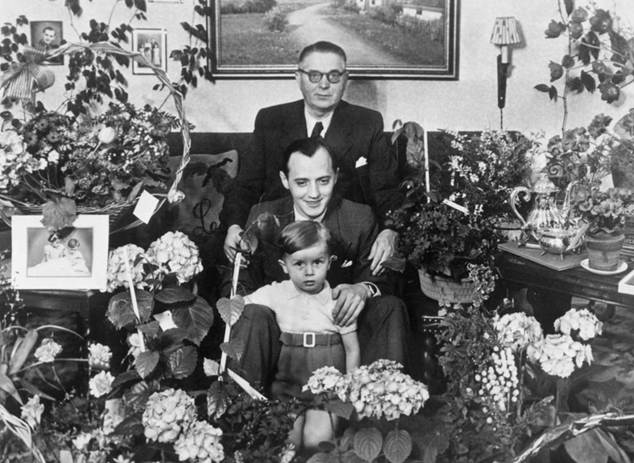
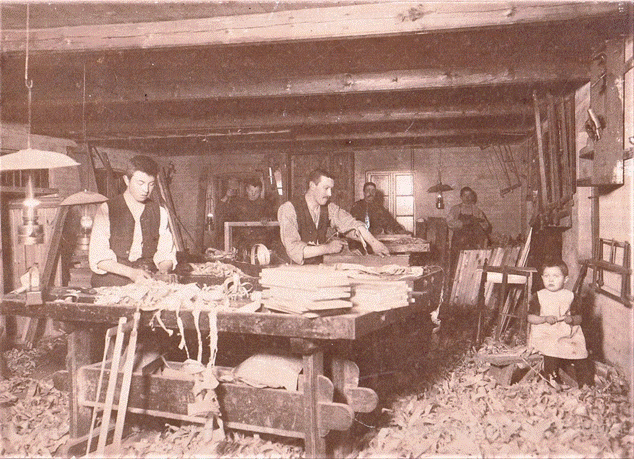
In 1916, Christiansen returned to Denmark and established his carpentry business in Billund, purchasing a woodworking shop called “Billund Maskinsnedkeri og Tømreforretning” (Billund Woodworking and Carpentry Shop). Initially, the business focused on constructing buildings and producing household goods for the local community. However, tragedy struck in 1924 when a fire destroyed his workshop, and later in 1932, his wife Kirstine died, leaving him alone with four sons.
The Birth of LEGO (1932-1949)
The Great Depression forced Christiansen to adapt his business model. On August 10, 1932, he began crafting wooden toys as a means of survival, creating miniature versions of his carpentry products like stepladders and ironing boards. These tiny replicas inspired him to focus entirely on toy production.
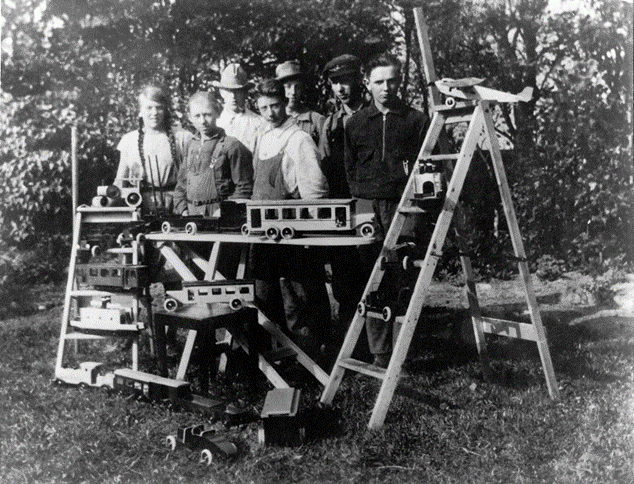
In 1934, Christiansen held a competition among his employees to name the company, offering a bottle of homemade wine as a prize. He chose “LEGO,” a contraction of the Danish phrase “leg godt,” meaning “play well”. Coincidentally, the word “Lego” also means “I put together” or “I assemble” in Latin.
The company’s motto, “only the best is good enough” (Danish: “det bedste er ikke for godt”), was created in 1936 and remains the company’s guiding principle today. This philosophy emphasized quality above all else, a value that would define the brand throughout its history.
The Revolutionary Transition to Plastic (1947-1958)
The First Injection Molding Machine
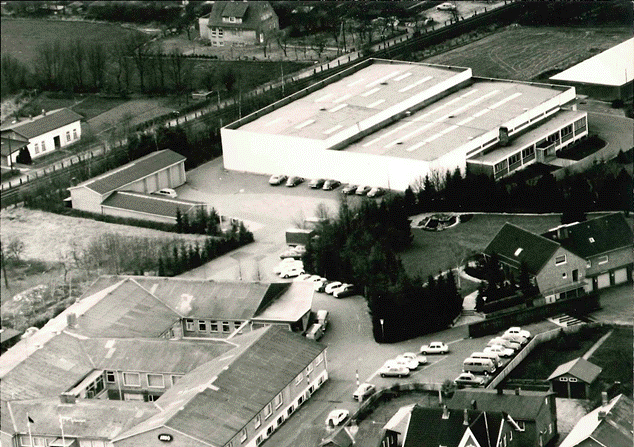
After World War II, sourcing quality beechwood became increasingly difficult. In June 1946, Ole Kirk attended a demonstration of a plastic injection molding machine in Copenhagen. Despite the machine costing 30,000 crowns—more than double the previous year’s profits—he ordered a British Windsor SH machine, which arrived in Billund in December 1947.
The Automatic Binding Bricks
In 1949, LEGO introduced its first plastic building blocks, called “Automatic Binding Bricks”—the forerunner to modern LEGO bricks. The English name was chosen as a tribute to the Allied forces who liberated Europe. These early bricks were based on Kiddicraft Self-Locking Bricks, invented by British designer Hilary Page in 1939.
By 1951, plastic toys accounted for half of the company’s output, despite skepticism from the Danish trade magazine “Legetøjs-Tidende,” which claimed plastic would never replace traditional wooden toys.
The System Revolution (1954-1958)
The Birth of System Thinking
In 1954, Godtfred Kirk Christiansen attended the London Toy Fair, where he met Troels Petersen, a toy buyer who complained about the lack of systematic thinking in the toy industry. This conversation sparked Godtfred’s vision for a comprehensive toy system.
Godtfred developed six core principles for the LEGO System in Play:
- Compact dimensions without limiting imagination
- Reasonably priced
- Simple and durable with unlimited variety
- Suitable for all ages and both genders
- Classic presentation requiring no renewal
- Easy distribution
The Revolutionary Patent
On January 28, 1958, at precisely 1:58 PM, the LEGO Group submitted a patent application for “a toy building element”. This patent introduced the revolutionary stud and tube principle—hollow tubes on the underside of bricks that created perfect “clutch power” with the studs on top. This innovation meant that six 2×4 bricks could be combined in 915,103,765 different ways.
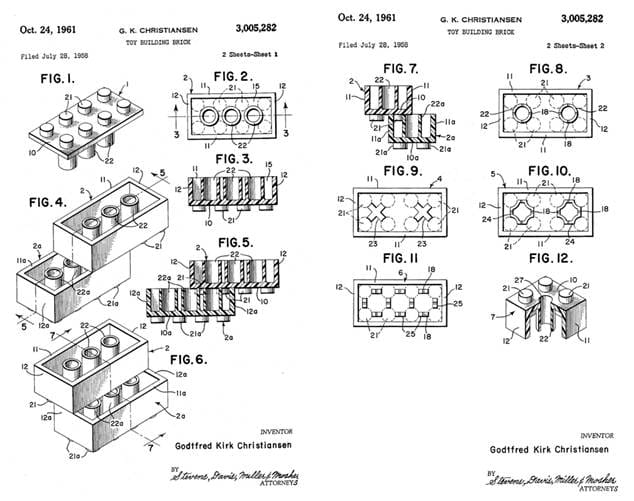
The patent was granted on October 24, 1961, and expired in 1978, opening the door for competitors but establishing LEGO’s dominance in the interlocking brick market.
Family Legacy and Leadership Succession
Second Generation: Godtfred Kirk Christiansen
When Ole Kirk died in 1958, his son Godtfred Kirk Christiansen (1920-1995) took over the company. Under Godtfred’s leadership, LEGO transitioned completely to plastic production in 1960, discontinuing wooden toys to focus entirely on the brick system.
Third Generation: Kjeld Kirk Kristiansen
Kjeld Kirk Kristiansen (born December 27, 1947) served as president and CEO of The LEGO Group from 1979 to 2004. The grandson of founder Ole Kirk, he oversaw massive expansion and modernization of the company. According to the Bloomberg Billionaires Index, Kristiansen has a net worth of US$7.92 billion as of March 2025.
Fourth Generation: Thomas Kirk Kristiansen
In May 2023, the family completed a generational handover from third to fourth generation. Thomas Kirk Kristiansen became Chairman of KIRKBI A/S, the family’s private holding company, with Agnete Kirk Kristiansen serving as Deputy Chair. The family maintains 75% ownership of the LEGO Group through KIRKBI.
Global Expansion and International Strategy
Early International Growth (1950s-1960s)
LEGO’s international expansion began in the 1950s with Nordic countries. Licensed production started in Norway in 1953, followed by Sweden and Iceland in 1955. Germany became the gateway to Europe, with Godtfred declaring, “If we can conquer Germany, we can conquer the whole world!”.
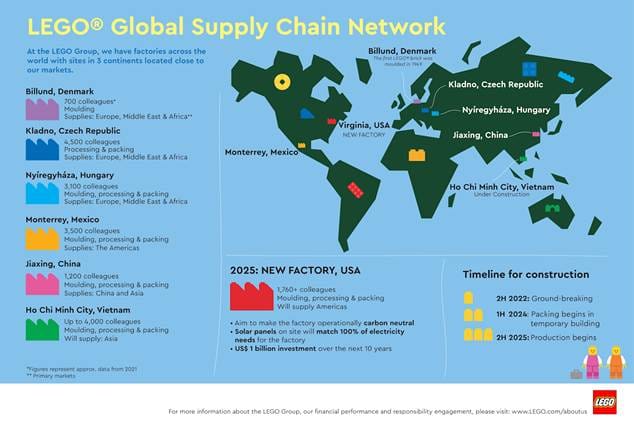
Modern Global Manufacturing Network
Today, LEGO operates six factories worldwide:
- Billund, Denmark (1947): The original facility, producing over 20 billion bricks annually
- Kladno, Czech Republic: Specializes in decoration and packaging
- Nyíregyháza, Hungary (2002): One of Europe’s largest production centers
- Monterrey, Mexico: Primary production center for the Americas
- Jiaxing, China (2016): Serves the Asia-Pacific market
- Binh Duong, Vietnam (2025): The newest carbon-neutral factory
A seventh factory in Virginia, USA, is planned to open in 2027.
Distribution Strategy
LEGO operates four regional distribution centers globally, with plans to have two in each major region. The company opened a new European distribution center in Belgium in 2024, investing €70 million in the facility. This strategic network enables the company to serve over 140 countries worldwide.
Entertainment Empire: Beyond the Brick
Theme Parks: LEGOLAND
The first LEGOLAND park opened on June 7, 1968, in Billund, Denmark, attracting 625,000 visitors in its first season. The park was created to showcase LEGO models and promote the toy business, as the factory was already drawing 20,000 visitors annually by the mid-1960s.
Today, there are 11 LEGOLAND parks in operation worldwide:
- Europe: Billund (Denmark), Windsor (UK), Deutschland (Germany), Gardaland Water Park (Italy)
- North America: California, Florida, New York
- Asia: Malaysia, Dubai, Japan, Korea, Shanghai
- Planned: Beijing, Shenzhen, Sichuan (China)
The parks are operated by Merlin Entertainments, which shares common ownership with LEGO through KIRKBI A/S.
Movies and Television
LEGO’s entertainment ventures began with Bionicle films in 2003, partnering with Miramax. The breakthrough came with “The Lego Movie” (2014), which grossed $468.1 million worldwide on a $60 million budget. The success spawned an entire cinematic universe including:
- The Lego Movie (2014)
- The Lego Batman Movie (2017)
- The Lego Ninjago Movie (2017)
- The Lego Movie 2: The Second Part (2019)
The franchise has grossed over $1 billion at the worldwide box office. In 2024, Universal Pictures acquired rights to develop new LEGO films, starting with “Piece by Piece”.
Video Games
LEGO has been creating video games since the 1990s, with over 20 games featuring popular franchises. Notable series include:
- LEGO Star Wars (multiple titles)
- LEGO Harry Potter Collection
- LEGO Marvel Super Heroes
- LEGO DC Super-Villains
- LEGO Builder’s Journey
The company celebrates 30 years of games bringing players together through family-friendly experiences across console, PC, and mobile devices.
Financial Performance and Business Transformation
The Crisis Years (1990s-2000s)
Despite early success, the company faced severe financial difficulties in the late 1990s and early 2000s. The company diversified too broadly into video games, clothing, theme parks, and excessive licensed products, losing focus on its core brick business.
By 2003, LEGO was virtually bankrupt with:
- $800 million in debt
- $300 million loss in 2003
- Projected losses of up to $400 million for 2004
- Negative cash flow exceeding $160 million
The Remarkable Turnaround (2004-Present)
Jørgen Vig Knudstorp became CEO in 2004—the first non-family member to lead the company. His restructuring strategy focused on:
- Returning to core products: Selling non-essential assets and focusing on the brick system
- Operational efficiency: Reducing unique elements from 12,000 to 7,000 pieces
- Manufacturing consolidation: Streamlining production facilities
- Digital transformation: Embracing technology as a complement to physical play
Modern Financial Success
LEGO has experienced remarkable growth since its turnaround:
2024 Full Year Results:
- Revenue: DKK 74.3 billion (13% growth)
- Operating profit: DKK 18.7 billion (10% growth)
- Net profit: DKK 13.8 billion (5% growth)
H1 2025 Results:
- Revenue: DKK 34.6 billion (12% growth)
- Operating profit: DKK 9.0 billion (10% growth)
- Consumer sales: 13% increase
The company has grown revenue five times in the fifteen years since 2003, with sales exceeding $2 billion by 2014—representing approximately 900% growth over the decade following the turnaround.
Digital Transformation and Innovation
Digital Strategy
In 2022, LEGO announced plans to triple its digital team to over 1,800 employees globally, representing one of the largest investments in the company’s history. The company opened new digital offices in Copenhagen, London, Shanghai, and expanded facilities in Billund.
Key digital initiatives include:
- LEGO Digital Designer: Software for virtual building and 3D modeling
- LEGO Ideas: Platform for fan-created designs and co-creation
- LEGO Super Mario: Blending physical and digital play experiences
- Digital twins: Simulating physical components and production systems
Sustainability and Future Vision
LEGO has committed to significant sustainability goals:
- 47% certified mass balance purchases in 2024 (doubled from 18% in 2023)
- Carbon-neutral manufacturing facilities, including the new Vietnam factory
- Investment in renewable energy and sustainable materials
Legacy and Impact
From humble beginnings in a Danish carpentry workshop to becoming one of the world’s most valuable toy companies, LEGO has built an empire on the simple principle that “only the best is good enough”. The company’s journey from near-bankruptcy to record-breaking success demonstrates the power of focusing on core strengths while embracing innovation.
Today, LEGO produces over 100 billion bricks annually with precision of 0.005 millimeters, ensuring compatibility across all sets. The company operates 1,079 stores across 54 markets globally, serves customers in over 140 countries, and maintains its position as the world’s most profitable toy company.
The LEGO story exemplifies how a family business can evolve and adapt across generations while staying true to its founding values of creativity, quality, and the belief that play is fundamental to human development. As the company continues to expand into new markets and technologies, it remains committed to its mission of inspiring and developing children through the joy of building and creative play.
If you’d like to explore more topics or to access the required quiz for purchasing your raffle ticket, visit our main Quiz & Studies page.
Quiz
Each study material comes with a short practice quiz at the end. These quizzes are completely optional and designed to help you review what you’ve learned and prepare for the Big Quiz.
💡 Use them to test your knowledge in a fun, low-pressure way – no email or name required.
We’re always improving and updating our content. If you spot anything that seems off, don’t hesitate to reach out – your feedback truly matters to us!
👉 Ready to test yourself? Start the Practice Quiz below:
#1. Who was the founder of LEGO?
#2. On what date was the revolutionary LEGO brick patent submitted?
#3. How many different ways can six 2×4 LEGO bricks be combined?
#4. What does the name “LEGO” mean in Danish?
#5. When did LEGO first introduce plastic toys?
Results

Congratulations — you’ve mastered the LEGO story! You’ve just built your knowledge brick by brick, from the humble workshop in Billund to LEGO’s global success — and who knows? Your next creation might just be a win!

Almost there! You didn’t quite get all the answers right this time — but remember, even LEGO wasn’t built in a day. Take another look, learn something new, and try again. Every brick of knowledge gets you closer to the big win!