
The Little Prince by Antoine de Saint-Exupéry
Why The Little Prince Still Matters Today
The Little Prince (Le Petit Prince) by Antoine de Saint-Exupéry stands as one of the most extraordinary literary achievements of the 20th century, transcending cultural boundaries to become the second most translated book in human history after the Bible, with over 600 official translations and more than 200 million copies sold worldwide. This seemingly simple tale of a young prince who travels the universe in search of friendship and meaning has evolved from a wartime creation born in exile to a global cultural phenomenon that continues to inspire readers, artists, and philosophers across all continents and generations.
Written during Saint-Exupéry’s forced exile in New York between 1940 and 1943, the novella emerged from the author’s profound homesickness, his disillusionment with adult society’s materialistic values, and his urgent desire to preserve the sense of wonder and authentic human connection that he felt was disappearing from the world. The book’s enduring appeal lies not merely in its surface simplicity as a children’s story, but in its sophisticated exploration of universal themes including love, loss, responsibility, friendship, and the fundamental question of what makes life meaningful—themes that resonate as powerfully today as they did when first published simultaneously in French and English in April 1943.
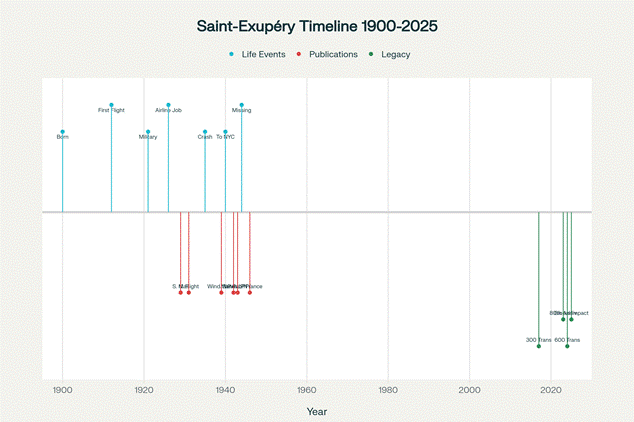
Antoine de Saint-Exupéry’s Life and Aviation Legacy
Early Life in France and the First Flight
Antoine Marie Jean-Baptiste Roger, Vicomte de Saint-Exupéry, was born into an aristocratic family in Lyon, France, on June 29, 1900, during an era when aviation was still in its infancy and literature remained dominated by traditional forms. His father died when Antoine was only four years old, leaving his mother, Marie Boyer de Fonscolombe, to raise five children with limited financial resources, forcing the family to rely on the generosity of relatives. This early experience of loss and financial instability would profoundly influence Saint-Exupéry’s worldview and his later literary exploration of themes concerning human vulnerability and the importance of genuine relationships over material wealth.
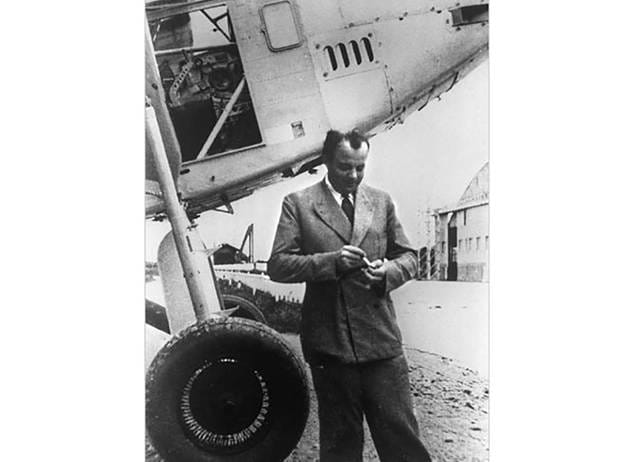
The defining moment of Saint-Exupéry’s youth occurred in 1912 when, at age twelve, he experienced his first airplane flight with pilot Gabriel Salvez-Wroblewski at the Ambérieu airfield. This brief flight, lasting only a few minutes, ignited a lifelong passion for aviation that would shape both his career and his literary imagination. Years later, Saint-Exupéry would write that this experience opened his eyes to “a new dimension of the world” and planted the seeds of his lifelong obsession with flight as both a practical endeavor and a metaphor for human transcendence.
Despite his aristocratic background and early academic promise, Saint-Exupéry proved to be a mediocre student who struggled with traditional educational structures. His initial ambition to join the French Naval Academy ended in disappointment when he failed the entrance examination, forcing him to briefly study architecture at the École des Beaux-Arts in Paris. However, this academic setback ultimately redirected him toward aviation, where he would discover both his true calling and the experiential foundation for his literary career.
Airmail Pilot Years and Writing Career
Saint-Exupéry’s professional aviation career began in 1921 during his compulsory military service, when he transferred from the cavalry to the French Air Force and learned to pilot aircraft at Istres. By 1922, he had earned his pilot’s wings and achieved the rank of second lieutenant, marking the beginning of a twenty-year career that would take him from the mail routes of Europe and Africa to reconnaissance missions over Nazi-occupied France. His initial engagement to Louise de Vilmorin ended when her family objected to his dangerous profession, a rejection that sent him into a period of depression but also intensified his commitment to aviation.
In 1926, Saint-Exupéry joined Aéropostale, the pioneering French airmail company, as a pilot flying routes between Toulouse, Spain, and French Morocco. This period proved transformative both personally and artistically, as he discovered that the solitude and danger of early aviation provided profound material for literary reflection. His experiences flying over the Sahara Desert, rescuing downed pilots, and confronting the fundamental questions of human existence in the face of nature’s indifference became the foundation for all his major works.
The 1920s and 1930s represented Saint-Exupéry’s most productive period as both aviator and writer, during which he published his first novels while continuing to push the boundaries of commercial aviation. His debut work, Southern Mail (1929), drew directly from his experiences flying the Casablanca-Dakar route and established the literary template he would follow throughout his career: using aviation adventures as launching points for deeper philosophical meditations on courage, duty, and human solidarity. The international success of Night Flight (1931), which chronicled the heroic early days of night postal flights in South America, established Saint-Exupéry as a major literary figure while validating his belief that modern aviation could serve as a vehicle for timeless human truths.
The 1935 Sahara Crash That Inspired the Story
The most significant event in Saint-Exupéry’s pre-war life occurred in December 1935, when he and his mechanic André Prévot crashed their Simoun aircraft in the Libyan desert while attempting to break the Paris-to-Saigon speed record. The crash left them stranded without adequate water or food in one of Earth’s most inhospitable environments, beginning an ordeal that brought them to the brink of death from dehydration. For four days, they wandered through the desert experiencing hallucinations and accepting the probability of their deaths, until a Bedouin found them and provided the water that saved their lives.
This near-death experience in the desert profoundly affected Saint-Exupéry’s spiritual and philosophical outlook, providing him with first-hand knowledge of human fragility and the essential importance of human solidarity in the face of natural indifference. The crash became the subject of his masterpiece memoir Wind, Sand and Stars (1939), which won both the Grand Prize for Literature from the French Academy and the National Book Award in the United States. More importantly for literary history, this desert experience provided the geographical and emotional backdrop for The Little Prince, in which a stranded aviator encounters a mysterious child in the Sahara.
Wartime Exile in New York and the Creation of The Little Prince
Leaving Occupied France (1940–1941)
The outbreak of World War II in 1939 marked the beginning of the final and most productive phase of Saint-Exupéry’s life, during which personal tragedy and global catastrophe converged to inspire his greatest literary achievement. Despite being overage for military service and suffering from numerous injuries sustained in aviation accidents, Saint-Exupéry volunteered for combat duty with the Reconnaissance Group 2/33 of the French Air Force. His service during the German invasion of France in May and June 1940 exposed him to the chaos and futility of modern warfare, experiences he would later chronicle in Flight to Arras (1942).
Following France’s armistice with Germany in June 1940, Saint-Exupéry found himself in an impossible situation: his books were banned by the Vichy regime, his aviation career was effectively ended, and his homeland was occupied by Nazi forces. Like thousands of other French intellectuals and artists, he made the difficult decision to leave France for the United States, arriving in New York in January 1941 with little more than his manuscripts and his determination to continue fighting fascism through his writing.
The period of American exile from 1941 to 1943 represented both the nadir of Saint-Exupéry’s personal life and the pinnacle of his creative achievement. Cut off from his homeland, his flying career, and many of his closest friends, he struggled with profound depression, financial difficulties, and a sense of purposelessness that was only partially alleviated by his work with the Free French movement. However, this period of isolation and reflection also provided him with the psychological distance necessary to distill his life experiences into their most essential elements, ultimately producing The Little Prince.
Writing and Illustrating the Manuscript (1942–1943)
Saint-Exupéry wrote The Little Prince during 1942 and early 1943 while living in various locations around New York City, including a apartment on Central Park South and a rented house on Long Island. The Morgan Library’s collection of the surviving manuscript pages and preliminary drawings provides extraordinary insight into his creative process, revealing a perfectionist who worked through multiple drafts and constantly revised both text and illustrations. He typically wrote at night, often until dawn, sustained by coffee and cigarettes while reading passages aloud to trusted friends for their reactions.
The physical manuscript, written on thin paper watermarked “Fidelity Onion Skin. Made in U.S.A.,” demonstrates Saint-Exupéry’s meticulous attention to both literary and visual elements. The Morgan collection includes 35 full-page drawings and numerous smaller sketches integrated into the manuscript pages, most of which differ significantly from the published illustrations. This extensive revision process reflects Saint-Exupéry’s determination to achieve perfect integration between text and image, creating a work that would communicate its themes through multiple sensory channels.
Contemporary accounts describe Saint-Exupéry during this period as a man torn between profound homesickness and creative inspiration. Friends reported that he would often call them at two in the morning to read newly written passages, seeking feedback and validation for work that he sensed might be his most important. The urgency of this creative process reflected not only his artistic perfectionism but also his premonition that his time might be running short—a presentiment that proved tragically accurate when he disappeared during a reconnaissance mission just over a year after the book’s publication.
The Little Prince Themes and Symbols Explained
The Central Narrative Structure
The Little Prince employs a deceptively simple narrative structure that disguises its sophisticated exploration of philosophical themes. The story unfolds as a frame narrative, with the adult narrator—a pilot stranded in the Sahara Desert—recounting his encounter with the mysterious little prince to readers he addresses directly. This narrative technique creates multiple layers of meaning, as the pilot’s story simultaneously functions as an adventure tale, a philosophical meditation, and an allegory of spiritual awakening.
The little prince’s interplanetary journey serves as a picaresque framework that allows Saint-Exupéry to present a series of satirical portraits of adult behavior. Each planet the prince visits represents a different form of adult obsession or spiritual poverty: the king who rules over nothing, the conceited man who craves admiration, the tippler who drinks to forget his shame at drinking, the businessman who counts stars he believes he owns, the lamplighter who mindlessly follows orders, and the geographer who records places he has never seen. These encounters build toward the prince’s arrival on Earth, where his meeting with the fox provides the story’s philosophical climax and his encounter with the narrator offers possibilities for redemption and understanding.
The Rose (Love, Ego, Responsibility)
The rose, whom the little prince tends on his home asteroid, represents one of literature’s most complex symbols of love, responsibility, and human relationships. Initially presented as vain, demanding, and difficult, the rose embodies the contradictions inherent in intimate relationships, requiring patience, understanding, and commitment despite her imperfections. The prince’s initial confusion and frustration with the rose’s behavior reflects the universal challenge of learning to love another being authentically rather than ideally.
The rose’s significance deepens when the prince discovers a garden of five thousand roses on Earth, initially devastating him with the realization that his rose is not unique in the universe. However, the fox’s subsequent lesson about “taming” transforms the prince’s understanding, helping him realize that his rose’s value lies not in her objective uniqueness but in their shared history of care and mutual dependence. This revelation encapsulates one of the story’s central themes: that meaning and value emerge through relationships and emotional investment rather than through inherent properties or rational analysis.
The rose’s thorns, initially puzzling to the prince, ultimately represent the defensive mechanisms that vulnerable beings employ to protect themselves from harm. Saint-Exupéry’s biographical parallels are significant here, as many critics have noted similarities between the rose’s temperamental behavior and that of his wife Consuelo, whose own memoir, The Tale of the Rose, confirmed these connections. Through the rose, Saint-Exupéry explores the idea that authentic love requires accepting another’s defenses and vulnerabilities as integral parts of their being.
The Fox (Friendship, “Taming,” and the Famous Quote)
The fox represents the story’s philosophical heart, serving as both character and teacher who articulates many of the novella’s most important themes. The fox’s request to be “tamed” by the little prince introduces the central concept of creating meaningful connections through mutual investment and shared experience. The word “tame” in this context transcends its usual meaning of domestication, instead referring to the process by which beings create unique bonds that transform both participants.
The fox’s most famous teaching—”It is only with the heart that one can see rightly; what is essential is invisible to the eye”—serves as the story’s philosophical core and its implicit critique of adult society’s materialistic values. This statement encapsulates Saint-Exupéry’s belief that rationalism and material concerns have blinded modern humans to life’s most important truths: love, friendship, beauty, and spiritual connection. The fox’s wisdom suggests that authentic perception requires emotional intelligence and intuitive understanding rather than analytical reasoning.
The fox’s explanation of the taming process—that it creates connections that make both parties unique to each other—provides the framework for understanding all the story’s relationships. Through the fox, Saint-Exupéry argues that meaning emerges through commitment and care rather than through casual encounter, and that responsibility for others is not a burden but the source of life’s deepest satisfactions.
Adult Characters as a Critique of Modern Life
The Little Prince functions as a comprehensive critique of adult society’s priorities, presenting a series of characters whose obsessions represent different forms of spiritual emptiness. The adults on the various planets embody specific failings that Saint-Exupéry saw as characteristic of modern civilization: the pursuit of power without purpose, the desire for admiration without achievement, escapism through self-destruction, the commodification of beauty and wonder, blind obedience to meaningless routine, and the accumulation of knowledge without wisdom.
The story’s famous opening, in which the child narrator’s drawing of a boa constrictor eating an elephant is consistently misidentified by adults as a hat, establishes this theme immediately. This misunderstanding represents adults’ inability to see beyond surface appearances and their tendency to reduce imaginative, complex realities to mundane, practical categories. The narrator’s subsequent decision to abandon drawing and become a pilot reflects the way society pressures children to abandon creativity and wonder in favor of “practical” pursuits.
Saint-Exupéry’s critique extends beyond individual failings to encompass systemic problems in modern society. The story suggests that adult civilization has become so focused on efficiency, material acquisition, and rational analysis that it has lost touch with the emotional and spiritual dimensions of human experience. This critique was particularly poignant given the wartime context in which Saint-Exupéry wrote, as he witnessed mechanized warfare and political systems that reduced human beings to statistics and strategic assets.
Themes of Memory, Loss, and Transcendence
The Little Prince explores the complex relationship between memory, loss, and spiritual transcendence through its treatment of the prince’s departure from Earth. The prince’s decision to allow the snake to bite him, enabling his return to his asteroid and his rose, can be interpreted multiple ways: as suicide, as spiritual transformation, as return to innocence, or as metaphor for the way profound experiences transcend physical boundaries. The ambiguity is intentional, allowing readers to find meaning appropriate to their own experiences of loss and separation.
The story’s conclusion emphasizes the narrator’s transformed relationship to memory and meaning. His request that readers who encounter a blonde child in the desert should write to inform him demonstrates his hope that the prince’s influence will continue beyond their brief encounter. This ending suggests that meaningful relationships transcend physical presence, living on in memory and continued commitment to the values those relationships represent.
The theme of transcendence is reinforced through Saint-Exupéry’s treatment of the desert setting, which serves as both literal location and spiritual landscape. The desert’s vastness and apparent emptiness mirror the spiritual emptiness of adult civilization, while its hidden beauty and life-sustaining oases represent the rewards available to those who look beyond surface appearances. The desert setting also connects The Little Prince to Saint-Exupéry’s own transformative experience following his 1935 crash, suggesting that profound spiritual insights often emerge from encounters with mortality and vulnerability.
Publication History and Early Reception
Why It Was First Published in the USA
The publication of The Little Prince in April 1943 occurred under extraordinary circumstances that reflected both the global disruption of World War II and Saint-Exupéry’s unique position as a French exile in America. Unlike his previous works, which had been published first in France and subsequently translated, The Little Prince appeared simultaneously in both French and English editions from the American publisher Reynal & Hitchcock. This unprecedented dual-language publication reflected both practical necessity—French publishers were operating under German occupation—and Saint-Exupéry’s desire to reach both French and American audiences with his urgent message about human values.
The publishing contract, signed in January 1943, granted Saint-Exupéry a $3,000 advance for two books, though he would complete only The Little Prince before his death. The author took unprecedented control over the book’s visual presentation, personally specifying the position, size, and captions for all illustrations. Both editions were priced at $2 and appeared in nearly identical formats, though the English translation by journalist Katherine Woods comprised approximately 17,000 words—3,000 more than the French original—reflecting the challenges of cross-cultural translation.
French Release After WWII and Rising Popularity
The timing of publication proved tragically prescient: just as The Little Prince reached bookstores, Saint-Exupéry received orders to rejoin his reconnaissance squadron in North Africa. He sailed from New York carrying a single copy of the newly printed French edition, a poignant detail that underscores the book’s personal importance to its author. His disappearance during a reconnaissance mission over occupied France on July 31, 1944, meant that he never witnessed the book’s gradual emergence as a global phenomenon.
The initial critical reception of The Little Prince was mixed, with reviewers struggling to categorize a work that seemed to exist between multiple genres and audiences. Many critics were unsure whether to approach it as children’s literature, adult philosophy, or autobiographical reflection. British author P.L. Travers, creator of Mary Poppins, argued that the book possessed “the necessary ingredients for a children’s book in that it is true in the most inward sense, it offers no explanations and it has a moral,” but other critics found its blend of simplicity and sophistication difficult to evaluate.
The book’s commercial performance during its first years was modest, reflecting both wartime publishing constraints and public uncertainty about its intended audience. However, The Little Prince benefited from Saint-Exupéry’s existing literary reputation, particularly the international success of Wind, Sand and Stars and Night Flight. American readers who had embraced Saint-Exupéry’s aviation memoirs gradually discovered the philosophical dimensions of his final work, while French readers had to wait until 1946 to read the book in their homeland.
The book’s transformation from critical curiosity to beloved classic occurred gradually through word-of-mouth recommendation and generational transmission. Unlike many literary works that achieve immediate recognition, The Little Prince built its reputation through individual readers who found personal meaning in its themes and shared the book with others. This grassroots process of discovery would prove crucial to the book’s eventual global reach, as it suggested that the story’s appeal transcended cultural and linguistic boundaries.
The Little Prince Translations and Global Cultural Impact
Over 600 Translations and Why It Matters
The Little Prince’s evolution into the world’s most translated work of fiction represents one of the most extraordinary publishing achievements in history. From its initial bilingual publication in 1943, the book has been translated into more than 600 languages and dialects, a milestone reached in 2024 with the completion of a translation into Dulegaya, the indigenous language of the Guna people of Panama and Colombia. This translation record surpasses all other works of fiction, placing The Little Prince second only to the Bible in terms of linguistic accessibility.
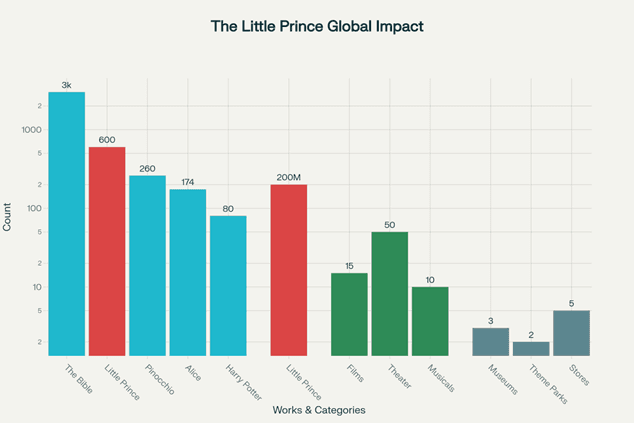
The translation history of The Little Prince reflects both its universal appeal and its particular significance for endangered languages. Many of the book’s translations have been undertaken not for commercial reasons but as acts of cultural preservation, with linguists and native speakers collaborating to render Saint-Exupéry’s text in languages spoken by only a few thousand people. The 300th translation, completed in 2017 in Hassaniya (a North African variant of Arabic), was particularly symbolic because Saint-Exupéry had lived among Hassaniya-speaking Moorish tribes during his time at Cape Juby in Morocco.
The global translation project has been coordinated through “The Little Prince at the Bedside of the World’s Languages,” an initiative that recognizes the book’s unique role in documenting and preserving linguistic diversity. Each translation represents not merely a linguistic exercise but a cultural bridge, allowing readers to encounter Saint-Exupéry’s themes through the conceptual frameworks and worldviews of their own languages. This process has revealed the story’s remarkable adaptability to different cultural contexts while maintaining its essential emotional and philosophical core.
Museums, Statues, and Cultural “Pilgrimage” Sites
The Little Prince has achieved particular cultural significance in several regions where it has been embraced as both literary work and cultural symbol. In France, the book has sold over 14 million copies and appears on the former 50-franc banknote alongside Saint-Exupéry’s portrait and imagery from his aviation career. The story’s themes of exile, loss, and the search for authentic human connection resonated powerfully with French readers rebuilding their society after World War II.
Why The Little Prince Became a Universal Symbol
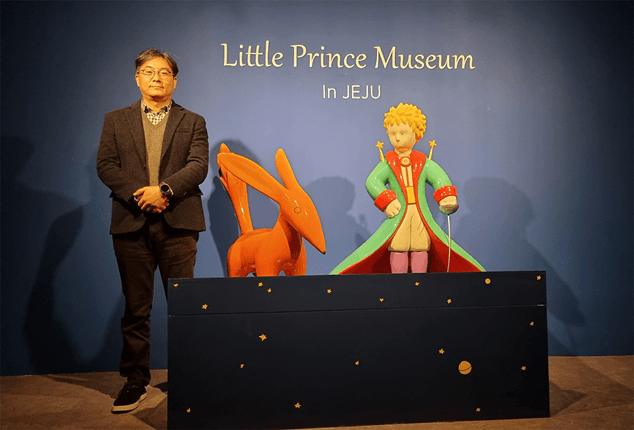
In East Asia, particularly Japan and South Korea, The Little Prince has inspired extensive cultural institutions including dedicated museums, theme parks, and educational programs. The Little Prince Museum in Jeju, South Korea, attracts hundreds of thousands of visitors annually and has become a pilgrimage site for readers seeking to connect with the story’s themes in a physical environment. The museum’s popularity reflects the book’s particular resonance in cultures that value contemplation, respect for childhood innocence, and philosophical reflection on life’s meaning.

Latin American cultures have embraced The Little Prince as a work that speaks to experiences of displacement, cultural identity, and the tension between traditional wisdom and modern materialism. The book’s translation into indigenous languages including Quechua has been particularly significant, as it has provided opportunities for native speakers to encounter global literature through their own linguistic traditions while simultaneously preserving these languages for future generations.
Adaptations of The Little Prince
Theatre and Broadway Productions
The Little Prince’s adaptation into theatrical form has produced some of the most innovative and successful stage productions of the past several decades, with companies worldwide creating interpretations that range from faithful literary adaptations to avant-garde artistic explorations. The story’s combination of narrative simplicity and thematic complexity has proven particularly suitable for theatrical presentation, allowing directors to explore its philosophical dimensions through visual spectacle, movement, and music.

The most successful recent adaptation opened in Paris in 2019 and has since toured globally, reaching Broadway in 2022 under the direction of Anne Tournié and Chris Mouron. This production employs dance, acrobatics, and aerial choreography to represent the little prince’s interplanetary journey, using movement as a universal language that transcends the linguistic barriers that might otherwise limit international touring. The Broadway production’s success demonstrates The Little Prince’s continued relevance for contemporary audiences and its adaptability to modern theatrical techniques.
Regional theatrical traditions have produced numerous culturally specific interpretations, including versions adapted for Hindi theater in India, Mandarin opera in China, and various European theater traditions. These adaptations often incorporate elements of local performance styles while maintaining the story’s core narrative and thematic elements, creating hybrid works that speak to both universal and culture-specific concerns.
Film and Animation (Including the 2015 Adaptation)
The Little Prince’s cinematic adaptations have included both live-action and animated films, with varying degrees of commercial and critical success. The 2015 Netflix animated film directed by Mark Osborne proved particularly innovative by creating an original frame narrative about a contemporary girl who discovers the story through her elderly neighbor, the original aviator. This approach allowed filmmakers to explore how Saint-Exupéry’s themes might resonate with modern children while honoring the original work’s artistic vision.
The film’s visual strategy of using different animation techniques—computer-generated imagery for the contemporary story and stop-motion animation for the classic tale—created a visual metaphor for the distinction between modern digital life and timeless human truths. This technical innovation reflected the directors’ understanding that The Little Prince’s appeal lies not merely in its plot but in its ability to evoke different ways of seeing and understanding the world.
Earlier film adaptations, including a 1974 musical directed by Stanley Donen, were less successful in capturing the book’s essential spirit, suggesting that the story’s philosophical dimensions require particularly thoughtful cinematic treatment. The challenge of adapting The Little Prince for film lies in translating its internal, contemplative nature into a visual medium that typically emphasizes external action and conventional narrative structure.
Musical and Operatic Versions
The Little Prince’s musical adaptations have included several major productions that attempt to capture the story’s lyrical qualities through song and orchestral composition. The most successful has been the French musical Le Petit Prince by composer Riccardo Cocciante, which premiered at the Casino de Paris in 2002 and has been revived multiple times. The musical’s success stems from its recognition that Saint-Exupéry’s text already possesses inherently musical qualities in its rhythmic language and emotional crescendos.
Operatic treatments of The Little Prince have explored the story’s themes of love, loss, and transcendence through the classical musical tradition’s established conventions for representing spiritual and emotional transformation. These adaptations often emphasize the relationship between the prince and his rose as a tragic love story, while using the prince’s journey as a framework for exploring different musical styles and emotional registers.
The story’s adaptability to musical treatment reflects its poetic language and the author’s careful attention to rhythm and sound in his prose. Saint-Exupéry’s background as a pilot familiar with the mechanics of machinery and the poetry of flight gave him an acute sensitivity to the musical dimensions of language, qualities that translate naturally to musical interpretation.
The Little Prince in the Digital Age
Relevance in a World of Screens and Speed
The Little Prince’s themes have achieved renewed relevance in the digital age, as contemporary society grapples with many of the same issues Saint-Exupéry identified in the 1940s: the prioritization of efficiency over relationships, the tendency to reduce complex realities to quantifiable data, and the loss of contemplative space in increasingly accelerated lives. The book’s critique of adults who are “too busy” to attend to essential truths resonates powerfully with contemporary concerns about work-life balance, social media distraction, and the commodification of human attention.
The story’s emphasis on the importance of face-to-face relationships and physical presence offers a counterpoint to digital communication technologies that enable global connection while sometimes diminishing the quality of interpersonal intimacy. The fox’s lesson about “taming” and creating unique bonds through shared time and attention speaks directly to contemporary questions about how authentic relationships can be maintained in an era of virtual interaction.
Environmental concerns have given new dimensions to The Little Prince’s treatment of the relationship between humans and their planetary home. The prince’s careful tending of his small asteroid, including his daily routine of pulling up baobab seedlings before they can grow large enough to destroy his world, has been interpreted as an allegory for environmental stewardship and the importance of addressing problems before they become catastrophic. This environmental reading has made the book particularly relevant to contemporary discussions about climate change and planetary sustainability.
Education, Therapy, and Life-Lessons
The Little Prince has found extensive application in educational settings worldwide, where teachers use its accessible narrative structure to introduce complex philosophical concepts to students of various ages. The story’s combination of adventure, humor, and profound themes makes it particularly effective for engaging reluctant readers while providing sophisticated content for advanced students. Many educational programs use the book as a starting point for discussions about ethics, relationships, cultural differences, and the nature of wisdom.
Therapeutic applications of The Little Prince have emerged in various contexts, including grief counseling, relationship therapy, and programs for individuals dealing with depression and anxiety. The story’s treatment of loss, its emphasis on the healing power of human connection, and its gentle approach to difficult emotions make it particularly suitable for therapeutic contexts. Many therapists report that clients find comfort and insight in the book’s suggestion that meaningful relationships transcend physical separation and that love creates lasting bonds that death cannot destroy.
The book’s availability in hundreds of languages has made it a valuable tool for language learning and cross-cultural communication. Many language programs use The Little Prince as a bridge text that allows students to encounter familiar themes and characters while developing proficiency in new languages. The story’s universal themes and relatively simple vocabulary make it particularly suitable for this purpose.
Manuscripts Online and Modern Reader Communities
The digital revolution has transformed how readers access and interact with The Little Prince, with electronic versions, audiobooks, and interactive applications making the story available to new audiences worldwide. Digital preservation efforts have ensured that even translations into endangered languages remain accessible for future generations, while online platforms have enabled global communities of readers to share interpretations and cultural adaptations.
The Morgan Library’s digitization of Saint-Exupéry’s original manuscripts and drawings has provided unprecedented access to the creative process behind The Little Prince, allowing readers and scholars worldwide to study the author’s revisions and artistic choices. This digital accessibility has enhanced understanding of the book as both literary work and artistic creation, revealing the careful thought that went into integrating text and image.
Social media platforms have created new communities of The Little Prince enthusiasts who share artwork, quotations, and personal reflections inspired by the story. These online communities demonstrate the book’s continued ability to inspire creative expression and meaningful conversation across cultural and linguistic boundaries. The ease of sharing visual content online has been particularly important for spreading awareness of the book’s illustrations and their artistic significance.
Legacy and Future Prospects
Academic and Scholarly Recognition
The Little Prince has achieved significant recognition in academic and scholarly contexts, with universities worldwide offering courses that examine the book’s literary techniques, philosophical themes, and cultural impact. Scholarly analysis has revealed layers of meaning that casual readers might miss, including connections to existentialist philosophy, critiques of industrial capitalism, and explorations of post-war European identity. The book’s interdisciplinary appeal has made it valuable for studies in literature, philosophy, psychology, anthropology, and cultural studies.
Research into The Little Prince’s translation history has contributed to broader understanding of how literary works cross cultural boundaries and adapt to different linguistic and conceptual frameworks. Scholars have used the book’s extensive translation record as a case study for examining how universal themes can be expressed through culture-specific language and imagery. This research has implications for translation studies, comparative literature, and international communication.
The preservation of Saint-Exupéry’s manuscripts and correspondence has enabled detailed biographical analysis that illuminates the connections between the author’s life experiences and his literary themes. Scholars have traced how specific events—including his desert crash, his marriage to Consuelo, his wartime experiences, and his American exile—contributed to the development of the story’s characters and situations. This biographical analysis has enhanced appreciation for the book as both artistic achievement and personal testimony.
Commercial and Cultural Industries
The Little Prince has generated extensive commercial activity through merchandise, tourism, and cultural institutions that extend the story’s influence beyond traditional publishing. Licensed products including clothing, toys, home décor, and stationery allow fans to incorporate the story’s imagery and themes into their daily lives. The careful management of these licensing arrangements has helped maintain the brand’s artistic integrity while making the characters and themes accessible to new audiences.
Tourism related to The Little Prince has created economic opportunities in multiple locations, including the museums in Japan and South Korea, the author’s hometown of Lyon, and locations in Morocco and Argentina where Saint-Exupéry lived and worked. These tourist destinations provide immersive experiences that allow visitors to explore the story’s themes in physical environments designed to evoke the book’s atmosphere.
The continuing commercial success of The Little Prince demonstrates the viability of literary properties that prioritize artistic and philosophical content over purely entertainment-based appeals. The story’s enduring popularity suggests that audiences worldwide continue to hunger for content that addresses fundamental questions about meaning, relationship, and authentic human values.
Future Cultural Evolution
As The Little Prince approaches its 85th anniversary in 2028, its cultural influence shows no signs of diminishing, with new translations, adaptations, and interpretations continuing to emerge globally. The story’s themes of environmental stewardship, authentic human connection, and resistance to materialistic values seem likely to become even more relevant as global society grapples with climate change, technological disruption, and social inequality.
Emerging technologies including virtual reality, artificial intelligence, and augmented reality offer new possibilities for experiencing The Little Prince in immersive environments that could bring readers closer to the story’s imaginative landscapes. However, these technological adaptations will need to preserve the book’s essential emphasis on simplicity and authentic human emotion to avoid undermining its core messages.
The continuing expansion of global literacy and education creates opportunities for The Little Prince to reach new audiences in regions where access to literature has historically been limited. As more languages develop written traditions and publishing industries, The Little Prince’s translation record is likely to grow, potentially reaching the goal of availability in every human language.
The story’s environmental themes suggest that it may play an important role in future global conversations about sustainability and humanity’s relationship with the natural world. As environmental challenges become increasingly urgent, The Little Prince’s gentle but persistent message about caring for one’s planetary home may prove prophetic.
Conclusion: What Is Essential Is Invisible to the Eye
The Little Prince’s transformation from a wartime creation born of exile and loss into humanity’s most widely translated work of fiction represents one of the most remarkable literary journeys in history. Saint-Exupéry’s simple tale of a child who travels among the stars in search of friendship and understanding has transcended every boundary of culture, language, and time to become a truly universal story that speaks to the deepest human needs for connection, meaning, and authentic relationship.
The book’s enduring appeal lies not in its surface simplicity but in its profound understanding of the paradoxes that define human existence: that the most important truths are invisible to rational analysis, that genuine wealth comes through giving rather than possessing, that childhood wonder represents not immaturity but the highest form of wisdom, and that love creates responsibilities that are simultaneously burdens and privileges. These insights remain as relevant today as they were when Saint-Exupéry first articulated them during humanity’s darkest hour, suggesting that the story’s influence will continue to grow as future generations encounter the same fundamental questions about how to live meaningfully in an often meaningless world.
As readers continue to discover The Little Prince in languages ranging from major international tongues to endangered indigenous dialects, they join a global community united by shared recognition that some truths transcend cultural boundaries and speak directly to the human heart. Saint-Exupéry’s achievement was to create a work that honors both the sophistication of adult experience and the clarity of childhood perception, offering a vision of human possibility that neither sentimentalizes innocence nor accepts cynicism as wisdom.
The Book’s Core Message in One Paragraph
The little prince’s final lesson—that what is essential is invisible to the eye—remains the story’s greatest gift to its readers: an invitation to see beyond surface appearances, to value relationships over possessions, to choose responsibility over freedom, and to remember that the most important things in life cannot be measured, counted, or captured, but only experienced through the heart’s capacity for wonder, love, and hope. In a world increasingly dominated by technological complexity and material abundance, this simple truth continues to offer guidance for those seeking authentic human connection and genuine meaning in their lives.
If you’d like to explore more topics or to access the required quiz for purchasing your raffle ticket, visit our main Quiz & Studies page.
Quiz
Each study material comes with a short practice quiz at the end. These quizzes are completely optional and designed to help you review what you’ve learned and prepare for the Big Quiz.
💡 Use them to test your knowledge in a fun, low-pressure way – no email or name required.
We’re always improving and updating our content. If you spot anything that seems off, don’t hesitate to reach out – your feedback truly matters to us!
👉 Ready to test yourself? Start the Practice Quiz below:
#1. The Little Prince is currently the second most translated book in the world after which work?
#2. What is the famous lesson that the fox teaches the Little Prince?
#3. In which year was The Little Prince first published?
#4. What happened to Antoine de Saint-Exupéry on July 31, 1944?
#5. How many languages and dialects has The Little Prince been translated into as of 2025?
Results

Bravo! You’ve “seen rightly with the heart.” Keep nurturing your curiosity and let the wisdom of The Little Prince guide your journey forward.

Almost there. Revisit the fox’s lesson, the rose, and the baobabs—then try again. What’s essential is waiting just beneath the surface.