
The Russo-Ukrainian War: History, Major Events, and Current Status Explained
The Russo-Ukrainian War represents the most significant military conflict in Europe since World War II, fundamentally reshaping the geopolitical landscape and challenging the post-Cold War international order. This protracted conflict, which began with Russia’s annexation of Crimea in February 2014 and escalated into a full-scale invasion on February 24, 2022, has resulted in hundreds of thousands of casualties, millions of displaced persons, and profound economic and political ramifications extending far beyond the immediate theater of operations. The war has exposed deep-seated tensions between Russia’s imperial ambitions and Ukraine’s aspirations for sovereignty and Western integration, while simultaneously testing the resolve and unity of the international community in upholding the principles of territorial integrity and national self-determination.
Historical Background and Root Causes of the Russo-Ukrainian War
Post-Soviet Independence and Early Tensions Leading to the Russo-Ukrainian War
Following the dissolution of the Soviet Union in 1991, Ukraine emerged as an independent state while maintaining initially cordial relations with Russia. The 1994 Budapest Memorandum on Security Assurances marked a pivotal moment in Ukrainian-Russian relations, as Ukraine agreed to surrender its Soviet-era nuclear weapons in exchange for security guarantees from Russia, the United Kingdom, and the United States regarding its territorial integrity and political independence. This agreement would later prove central to international criticism of Russia’s actions, as Moscow’s subsequent territorial violations directly contravened its commitments under the memorandum.
The early 2000s witnessed growing tensions as Ukraine increasingly sought closer ties with Western institutions, particularly NATO and the European Union. The 2004 Orange Revolution, triggered by allegations of electoral fraud in favour of pro-Russian candidate Viktor Yanukovych, demonstrated Ukraine’s democratic aspirations and civil society’s capacity for peaceful resistance. The revolution’s success in bringing pro-Western Viktor Yushchenko to power was viewed by Russian military officers as part of a broader pattern of Western-sponsored “color revolutions” designed to undermine Russian influence in its traditional sphere of influence.
The Georgian War Precedent and Its Role in the Russo-Ukrainian War
Russia’s invasion of Georgia in August 2008 served as a crucial precursor to its later actions in Ukraine, demonstrating Moscow’s willingness to use military force to prevent former Soviet states from pursuing NATO membership. The conflict resulted in Russia’s occupation of South Ossetia and Abkhazia, establishing a template for hybrid warfare that would later be employed in Ukraine. Significantly, the perceived weak Western response to the Georgian invasion encouraged Russian assessments that similar actions against Ukraine would not provoke decisive international retaliation.
The Euromaidan Protests and the Origins of the Russo-Ukrainian War
The immediate catalyst for the current conflict emerged in late 2013 when Ukrainian President Viktor Yanukovych, under intense Russian pressure, suddenly withdrew from signing an association agreement with the European Union. This decision sparked massive protests known as the Euromaidan, which evolved into the Revolution of Dignity as demonstrators demanded an end to government corruption, Russian interference, and authoritarian practices. The violent suppression of protesters, culminating in the deaths of over 100 demonstrators in February 2014, ultimately forced Yanukovych to flee to Russia and led to the establishment of an interim pro-Western government.
The 2014 Crisis: The First Phase of the Russo-Ukrainian War
The Annexation of Crimea in the Russo-Ukrainian War
Russia’s response to the Ukrainian revolution was swift and decisive. On February 27, 2014, unmarked Russian special forces, later dubbed “little green men,” began occupying key strategic points across the Crimean Peninsula. Initially denying Russian involvement, President Putin later admitted that these were Russian troops, justifying their presence as necessary to protect ethnic Russians and Russian speakers. The occupation followed a carefully orchestrated plan involving the seizure of the Crimean parliament, installation of a pro-Russian government under Sergey Aksyonov (whose party had received only 4% of votes in the previous election), and the organization of a disputed referendum on joining Russia.
The March 16, 2014 referendum, conducted under military occupation and without international oversight, purportedly showed overwhelming support for joining Russia, though the process was widely condemned as illegitimate. Russia formally annexed Crimea on March 18, 2014, in a move that violated international law and established a precedent for territorial conquest in 21st-century Europe. The annexation was strategically motivated by Crimea’s naval facilities, particularly the Sevastopol naval base housing Russia’s Black Sea Fleet, and its symbolic importance as historically Russian territory.
The War in Donbas as Part of the Russo-Ukrainian War
The conflict subsequently spread to eastern Ukraine, where pro-Russian protests in the Donetsk and Luhansk regions provided cover for Russian-sponsored separatist movements. On April 12, 2014, Russian citizen and former GRU colonel Igor “Strelkov” Girkin led a group of armed militants in seizing the cities of Sloviansk and Kramatorsk, effectively triggering the war in the Donbas. Girkin later admitted his role in initiating the conflict, stating that without his unit crossing the border, “everything would have fizzled out”.
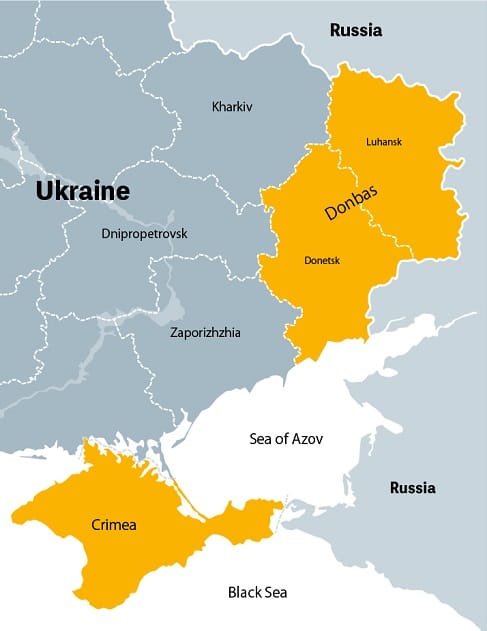
The separatists, supported by Russian weaponry, personnel, and regular military units, proclaimed the Donetsk People’s Republic (DPR) and Luhansk People’s Republic (LPR) as independent states. Ukraine’s Anti-Terrorist Operation, launched in response to the separatist uprising, faced significant challenges due to the Ukrainian military’s poor state of readiness and Russia’s covert but substantial support for the rebels. By August 2014, as Ukrainian forces began to gain ground against the separatists, Russia launched a direct military intervention, deploying thousands of regular troops and heavy equipment to prevent the collapse of the proxy republics.
The downing of Malaysia Airlines Flight 17 on July 17, 2014, which killed 298 civilians, marked a tragic escalation of the conflict and provided conclusive evidence of Russian involvement through the Buk missile system used in the attack. International investigations later confirmed that the missile system belonged to the Russian military and had been transported from Russia specifically for the attack.
Minsk Agreements and Stalemate in the Russo-Ukrainian War
The Minsk Protocol of September 2014 and the subsequent Minsk II agreement of February 2015 established ceasefire frameworks that, while reducing the intensity of fighting, never achieved lasting peace. The agreements became focal points for international diplomatic efforts but suffered from fundamental disagreements over implementation, particularly regarding the sequencing of political reforms and the withdrawal of foreign forces. Between 2014 and 2022, 29 separate ceasefires were agreed upon, yet none lasted more than two weeks, reflecting the intractable nature of the conflict.
The war in the Donbas settled into a pattern of static trench warfare characterized by regular artillery exchanges, sniper attacks, and special operations raids. Despite the relatively frozen frontlines, the conflict claimed over 14,000 lives between 2014 and 2021, with the majority being civilians caught in the crossfire. The extended period of low-intensity conflict served Russian strategic interests by maintaining pressure on Ukraine while avoiding the costs of full-scale war.
The 2022 Full-Scale Invasion of the Russo-Ukrainian War
Major Military Campaigns and Territorial Changes
Beginning in March 2021, Russia initiated a massive military buildup along Ukraine’s borders, eventually amassing over 190,000 troops in threatening positions around Ukraine and in Belarus. Throughout this period, Russian officials consistently denied any intention to invade, characterizing the deployments as routine military exercises. However, U.S. intelligence agencies accurately predicted Russian invasion plans, releasing satellite imagery and detailed intelligence assessments that proved prescient.
The diplomatic prelude to invasion involved increasingly aggressive Russian demands, including guarantees that Ukraine would never join NATO, the withdrawal of NATO forces from Eastern Europe, and recognition of Russian spheres of influence. These maximalist demands, which contradicted fundamental principles of national sovereignty and alliance choice, were rejected by Ukraine and NATO allies.
The Invasion Begins in the Russo-Ukrainian War
On February 24, 2022, at approximately 5:00 AM local time, President Putin announced a “special military operation” to “demilitarize and denazify” Ukraine, launching the largest military assault in Europe since World War II. The invasion began with coordinated missile and air strikes targeting military installations, airports, and command centers across Ukraine, followed by ground assaults from four primary axes: northern approaches toward Kyiv from Belarus, northeastern advances toward Kharkiv, southeastern operations in the Donbas, and southern offensives from Crimea toward Kherson and Mariupol.
Russian war plans, as later revealed through captured documents and intelligence assessments, anticipated a rapid campaign lasting 3-10 days that would result in the capture of Kyiv, the overthrow of the Ukrainian government, and the installation of a pro-Russian regime. The discovery of parade uniforms and ceremonial equipment among Russian forces suggested preparations for victory celebrations in Ukrainian cities. However, these optimistic assessments proved catastrophically wrong, as Russian forces encountered far stronger Ukrainian resistance than anticipated.
Initial Operations and Ukrainian Resistance in the beginning of the Russo-Ukrainian War
The first phase of the invasion (February 24 – April 7, 2022) witnessed dramatic battles for key Ukrainian cities and strategic objectives. Russian airborne forces attempted to seize Hostomel Airport near Kyiv to establish an air bridge for reinforcements, but fierce Ukrainian resistance prevented the airport’s use for its intended purpose. The battle for Kyiv’s suburbs, including fierce fighting in Bucha, Irpin, and Hostomel, became symbolic of Ukrainian determination to defend their capital.
Ukrainian forces, led by General Oleksandr Syrskyi, effectively utilized Western-supplied anti-tank missiles (Javelin) and anti-aircraft systems (Stinger) to disrupt Russian supply lines and prevent the encirclement of Kyiv. The successful defense of the capital, combined with longer-than-expected resistance in other sectors, forced Russia to abandon its northern offensive and withdraw forces for redeployment to other fronts.
Major Military Campaigns in the Russo-Ukrainian War
The Siege of Mariupol in the Russo-Ukrainian War
The siege of Mariupol (February-May 2022) became one of the war’s most symbolically and strategically significant battles. The port city’s location was crucial for establishing a land bridge between Russia and occupied Crimea, while its Azovstal steel plant served as the final stronghold for Ukrainian defenders. The 82-day siege resulted in extensive civilian casualties and the near-complete destruction of the city, with Russian forces employing indiscriminate bombing of civilian infrastructure including hospitals, schools, and residential areas.
The final Ukrainian defenders, including members of the Azov Regiment and regular marines, held out in the vast underground complex of the Azovstal steel works until May 20, 2022, when the last fighters surrendered after being ordered to do so by Ukrainian command. The fall of Mariupol provided Russia with its most significant territorial gain of the war, though at enormous cost in terms of international reputation and military resources.
Ukrainian Counteroffensives in the Russo-Ukrainian War
Ukraine’s successful counteroffensives in the autumn of 2022 marked a crucial turning point in the conflict. The Kharkiv counteroffensive (September 2022) caught Russian forces off-guard, resulting in the rapid liberation of over 8,000 square kilometers of territory and the retreat of Russian forces across the Oskil River. The success of this operation was attributed to superior Ukrainian operational security, effective use of Western-supplied equipment, and the concentration of forces at a carefully chosen point of attack.
The southern counteroffensive, culminating in the liberation of Kherson city in November 2022, demonstrated Ukraine’s growing military capabilities and forced Russia to withdraw across the Dnieper River. The Russian withdrawal from Kherson was particularly significant as it represented the only regional capital that Ukraine successfully recaptured during the war.
The 2023 Ukrainian Counteroffensive in the Russo-Ukrainian War
Ukraine’s much-anticipated 2023 summer counteroffensive aimed to break through heavily fortified Russian defensive lines in southern Ukraine, particularly in Zaporizhzhia Oblast. However, the offensive failed to achieve its strategic objectives, gaining only limited territory despite months of intensive fighting. The disappointing results highlighted the challenges of conducting offensive operations against prepared defensive positions supported by extensive minefields, drone surveillance, and concentrated artillery.
The Kursk Offensive in the Russo-Ukrainian War
In August 2024, Ukraine launched a surprise cross-border offensive into Russia’s Kursk Oblast, marking the first significant Ukrainian military operation on Russian territory. The incursion, which initially captured approximately 1,250 square kilometers of Russian territory, was designed to divert Russian forces from the main front in eastern Ukraine and potentially create bargaining leverage for future negotiations. However, Russian reinforcements, including North Korean troops, eventually contained the Ukrainian advance and recaptured much of the lost territory.
Current Military Situation and Frontlines of the Russo-Ukrainian War
Territorial Control and Static Warfare in the Russo-Ukrainian War
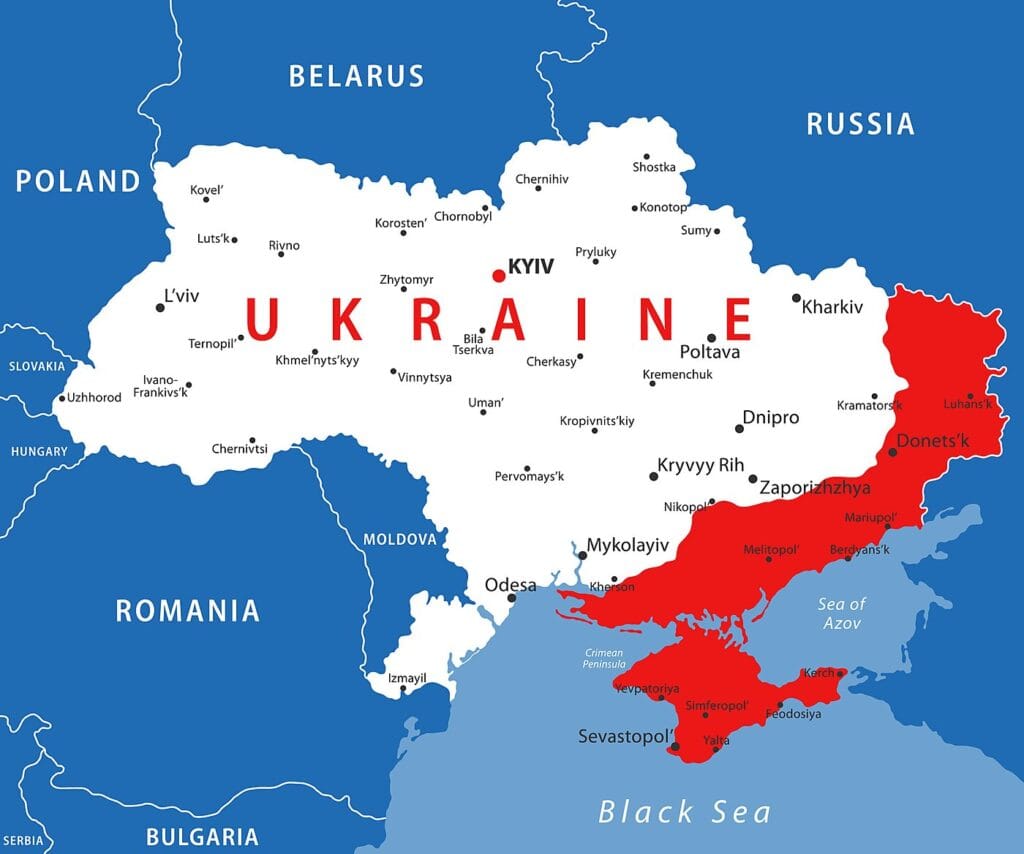
As of September 2025, Russia controls approximately 20% of Ukrainian territory, including Crimea (annexed in 2014) and significant portions of the Donetsk, Luhansk, Kherson, and Zaporizhzhia regions. The frontlines have largely stabilized into a pattern reminiscent of World War I trench warfare, with extensive defensive fortifications, minefields, and prepared positions limiting major territorial changes.
Russian forces continue to make incremental gains in eastern Ukraine, particularly around Pokrovsk and other strategic locations in Donetsk Oblast, but at enormous cost in personnel and equipment. The war has evolved into a grinding attritional contest where territorial gains are measured in hundreds of meters rather than kilometers, and both sides suffer heavy casualties for minimal strategic advantage.
Military Casualties and Human Cost of the Russo-Ukrainian War
The human cost of the conflict has been staggering, with casualty figures reaching historically unprecedented levels for post-World War II European conflicts. According to BBC Russian and Mediazona investigations using open-source intelligence, between 197,100 and 284,700 Russian servicemen have been killed in the conflict as of September 2025, with total Russian casualties (killed and wounded) estimated between 950,000 and 1 million. These figures represent losses roughly five times greater than all Soviet and Russian military deaths combined since World War II.
Ukrainian military casualties are less precisely documented due to operational security concerns, but President Zelensky acknowledged approximately 46,000 Ukrainian military deaths and 380,000 wounded as of early 2025. However, Western intelligence estimates suggest Ukrainian casualties may be higher, with some confidential assessments indicating up to 80,000 killed and 400,000 wounded.
Civilian casualties have reached at least 13,580 deaths and over 34,000 injuries according to UN verification, though actual numbers are likely significantly higher due to unreported deaths in occupied territories. The conflict has created Europe’s largest refugee crisis since World War II, with approximately 5.7 million Ukrainian refugees recorded globally and over 3 million internally displaced persons within Ukraine.
International Response to the Russo-Ukrainian War
NATO and Western Military Support in the Russo-Ukrainian War
The international response to Russia’s invasion has been unprecedented in its scope and coordination. NATO countries and other allies have provided over $380 billion in total aid to Ukraine since the invasion began, including approximately $118 billion in direct military assistance. The United States has been the largest single contributor, providing $114 billion in various forms of aid, while European nations have collectively contributed €132 billion.
Military aid has included advanced weapon systems such as Patriot air defense missiles, HIMARS multiple rocket systems, Javelin anti-tank missiles, and various artillery systems. The provision of these weapons has been coordinated through the Ukraine Defense Contact Group, comprising 57 member countries, and represents a significant shift in NATO policy regarding support for non-member states under attack.
Recent developments under the Trump administration have seen the implementation of a new funding mechanism called the Prioritized Ukraine Requirements List (PURL), which allows the transfer of weapons from U.S. stockpiles using NATO funding. This mechanism has authorized initial shipments worth up to $1 billion, including critically needed air defense systems.
Economic Sanctions and Their Impact on the Russo-Ukrainian War
The Western response has also included comprehensive economic sanctions targeting Russia’s financial system, energy sector, technology imports, and key individuals. Sanctions have frozen approximately $300 billion in Russian central bank assets, restricted access to SWIFT banking systems, and imposed price caps on Russian oil exports.
However, the effectiveness of sanctions remains debated. While Russia’s economy has experienced significant disruption, including high inflation (9.5% in 2024) and interest rates (21%), the country has demonstrated remarkable resilience. Russian GDP growth was actually 3.6% in 2024, higher than many Western economies, largely due to massive defense spending and continued energy exports to China and India.
Russia has successfully adapted to sanctions through various mechanisms, including the development of a “shadow fleet” of oil tankers that transported 167 million tonnes of oil in 2024, worth approximately $89 billion. Trade relationships with China, India, and other non-aligned countries have expanded significantly, with bilateral trade with China conducted almost entirely in rubles and yuan.
Diplomatic Efforts and Peace Negotiations in the Russo-Ukrainian War
Early Negotiation Attempts in the Russo-Ukrainian War
Multiple rounds of peace negotiations have occurred since the invasion began, with the most significant talks taking place in Istanbul in March 2022. These negotiations produced the Istanbul Communiqué, which outlined a potential framework involving Ukrainian neutrality in exchange for security guarantees from multiple countries. However, talks broke down due to disagreements over key provisions and Ukrainian concerns about Russian sincerity, particularly following the Bucha massacre.
Current Peace Initiatives to End the Russo-Ukrainian War
Renewed diplomatic efforts have emerged under the Trump administration, which has sought to broker negotiations between Russia and Ukraine. President Trump’s approach has involved direct communication with both Putin and Zelensky, though his initial unilateral engagement with Putin without including Ukraine raised concerns among European allies.
Russian negotiating positions have remained largely unchanged, demanding recognition of all occupied territories as Russian, guarantees that Ukraine will never join NATO, limitations on Ukrainian military capabilities, and the lifting of sanctions. Ukrainian positions continue to insist on the restoration of territorial integrity, the return of prisoners and deported children, prosecution of war crimes, and security guarantees to prevent future aggression.
European nations have proposed alternative frameworks, including the deployment of peacekeeping forces to secure any future ceasefire, though details remain under discussion. The concept of a “Coalition of the Willing” comprising European forces has gained traction as a potential mechanism for providing security guarantees to Ukraine.
Current Status and Future Outlook of the Russo-Ukrainian War
As of September 2025, the war continues with no clear resolution in sight. Recent developments include:
Military Situation: Russian forces continue incremental advances in eastern Ukraine while Ukrainian forces maintain defensive positions along largely static frontlines. Daily casualty rates remain high, with NATO officials estimating approximately 1,000 Russian casualties per day during peak fighting periods.
International Support: Western military aid continues through new mechanisms, though there are ongoing debates about sustainability and effectiveness. The Trump administration’s approach represents a shift toward burden-sharing with European allies while maintaining pressure on Russia for negotiations.
Economic Impact: Both countries face severe economic challenges, with Ukraine requiring massive reconstruction aid estimated in the hundreds of billions of dollars. Russia’s economy shows signs of strain from prolonged war spending and sanctions, though it retains capacity for continued operations.
If you’d like to explore more topics or to access the required quiz for purchasing your raffle ticket, visit our main Quiz & Studies page.
Quiz
Each study material comes with a short practice quiz at the end. These quizzes are completely optional and designed to help you review what you’ve learned and prepare for the Big Quiz.
💡 Use them to test your knowledge in a fun, low-pressure way – no email or name required.
We’re always improving and updating our content. If you spot anything that seems off, don’t hesitate to reach out – your feedback truly matters to us!
👉 Ready to test yourself? Start the Practice Quiz below:
#1. What was the name of the 2014 Ukrainian protest movement that led to the overthrow of pro-Russian President Viktor Yanukovych?
#2. Which Ukrainian city endured an 82-day siege and became symbolic of Ukrainian resistance before finally falling to Russian forces in May 2022?
#3. Approximately what percentage of Ukrainian territory does Russia currently control as of September 2025?
#4. According to BBC Russian and Mediazona investigations, approximately how many Russian servicemen have been killed in the conflict as of September 2025?
#5. When did Russia’s full-scale invasion of Ukraine begin?
Results

Excellent work—you’ve successfully completed the Russo-Ukrainian War quiz. Your answers show strong command of the conflict’s timeline, turning points, and geopolitical stakes. Keep building your knowledge to see the bigger picture.

You’re close—don’t give up. Conflicts this complex reward a second pass. Focus on dates, cause-and-effect, and who controlled what, when. Every attempt brings you closer to full understanding.